
Comparisons
Greenify vs. AG1: An Honest Head-to-Head
Last updated: August 2026
Two greens powders, two different sets of trade-offs. Here is the full table — including the lines where AG1 comes out ahead.
Greenify Editorial • July 22, 2026 • 7 min read
Written and fact-checked by the Greenify nutrition team against product labels and published nutrition guidance. Our editorial standards
- Comparison
- AG1
- Labels
- Daily Greens

Greenify vs AG1 is the comparison we get asked about most, so here it is in full. We sell one of the two products in this comparison, so the only version of it worth publishing is one that concedes the points we lose. AG1 beats us on probiotic CFU, on ingredient count and on guarantee length. We beat it on disclosed doses, on cost per day and on buying without a subscription. Below is every line item we could verify, followed by an honest read on who should buy which.
The full comparison
Everything below reflects publicly listed pricing and label information at the time of writing. Both formulas get revised, so treat the table as a snapshot with a date on it rather than a permanent fact, and check both panels before buying.
One methodological note: cost per day is calculated as total price divided by servings, at each brand's own advertised tiers. For Daily Greens that is $69.95 for a single 30-serving tub down to $209.85 for 150 servings. For AG1 it is the listed subscription price against the higher one-time price for the same 30-serving quantity.
A second note on what a comparison table can and cannot settle. Every row below is a specification, and specifications are the easy part of a supplement decision. They tell you what is in the tub, what it costs and what happens if you want your money back. They cannot tell you whether a formula suits your stomach, whether you like the taste enough to keep going past week three, or whether the specific gaps in your own diet are the ones a given blend happens to fill. Treat the table as a shortlist tool rather than a verdict, and treat your own eight-week trial as the real evidence.
It is also worth saying what both products have in common, because that is most of the panel. Both are once-daily powders. Both use a non-nutritive sweetener rather than added sugar. Both include greens, fruit and vegetable powders, botanical extracts and a vitamin and mineral component. Both are sold direct-to-consumer with a money-back window. The differences below are real and worth money, but nobody should imagine these are products from different categories.
| Greenify Daily Greens | AG1 | |
|---|---|---|
| Price per serving | $1.40–$2.33 | ~$2.60–$3.30 |
| Servings per container | 30 | 30 |
| Best price without subscription | $1.40/day (3+2 bundle) | One-time price ~$99 (~$3.30/day) |
| Probiotic CFU | 2.5 billion, 4 strains | 10 billion |
| Digestive enzymes | 5, named on the panel | Included in blend |
| Ingredient count | 56 | ~75 |
| Blend weights disclosed | Yes — 2.6g / 1.2g / 406mg / probiotic blend | Largely proprietary |
| Adaptogens | Ashwagandha, Korean ginseng, eleuthero in 1.2g disclosed blend | Included, amounts not itemised |
| Sweetener | Stevia leaf extract, no added sugar | Stevia, no added sugar |
| Serving size | 4.4g | 12g |
| Subscription required | No | Yes for the advertised member price |
| Money-back guarantee | 60 days | 90 days |
| Made in | USA, GMP-certified facility | Manufactured to recognised standards, third-party tested |
Where AG1 wins
Probiotic CFU is the clearest one. Ten billion CFU per serving is four times what we carry, and there is no honest way to argue around that number. What we would add is context rather than rebuttal: CFU is a count, not a measure of benefit, and strain identity, survivability to the gut and the presence of prebiotic fiber all bear on whether a count means anything. But if you are shopping on CFU, AG1 has the bigger figure and we do not.
Ingredient count is the second. Roughly 75 versus our 56 is a real difference in breadth, and for someone who wants the widest possible net of plant compounds in a single scoop, breadth is a legitimate purchase criterion.
The third is the guarantee. Ninety days is a longer runway than our sixty, and in a category where benefits build slowly, a longer window is a real consumer protection. We chose 60 days because it is two full tubs, which we think is enough to judge; we are not going to pretend it is the more generous policy.
Add to that: subscription auto-ship genuinely helps some people keep a daily habit, and AG1's third-party banned-substance testing matters to anyone in drug-tested competition. If any of those describe you, buy AG1 with our blessing.
The disclosed-dose option
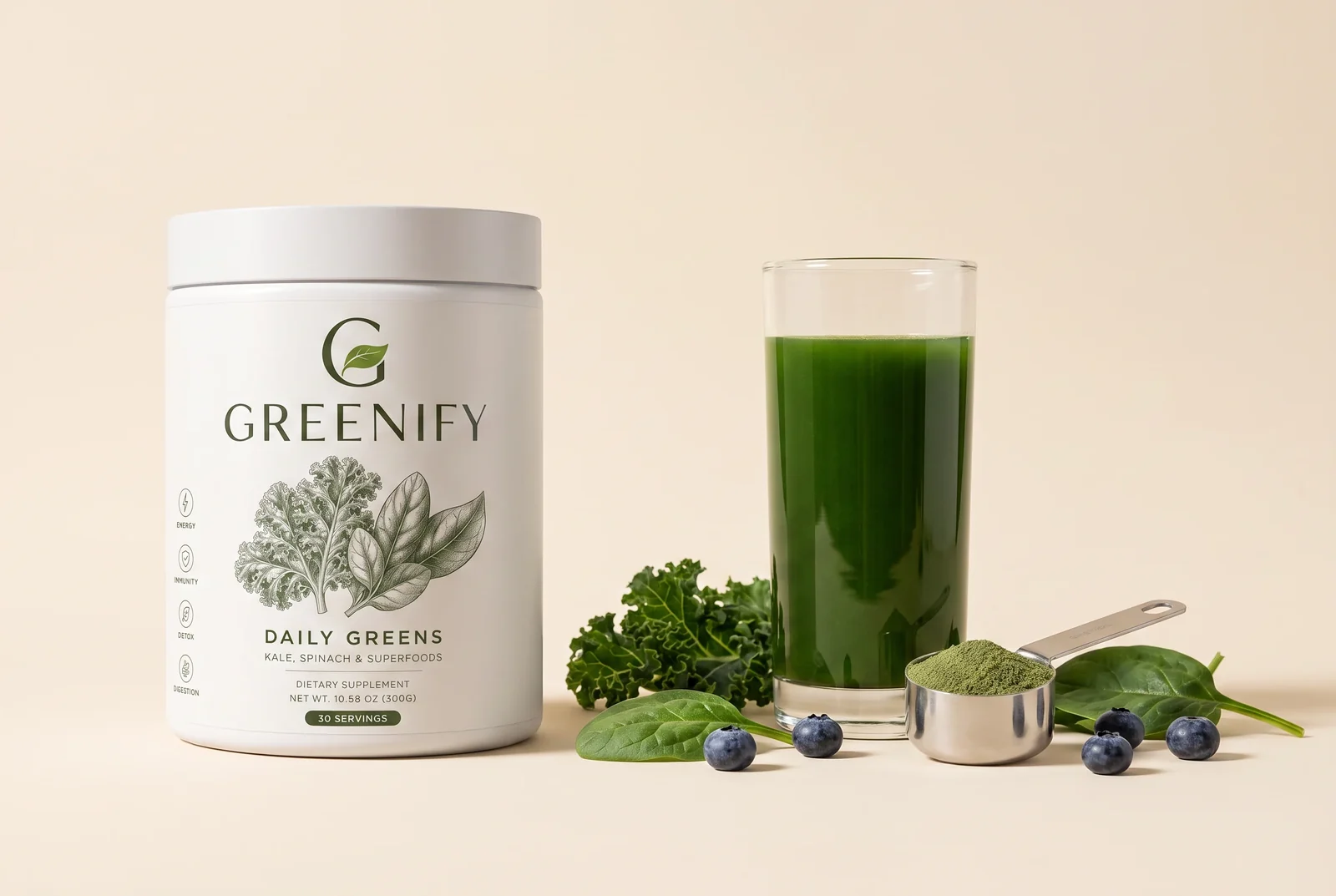
Daily Greens — 56 ingredients, four printed blends
$69.95 for 30 servings, or $1.40 a day on the 3+2 bundle. No subscription, free shipping on multi-packs, 60 days to change your mind.
Where Greenify wins
Disclosure is the reason this company exists. Our panel prints the weight of each of the four blends — 2.6g of superfoods, antioxidants and mushrooms; 1.2g of herbs and extracts; 406mg of prebiotic fiber with five named enzymes; and a four-strain probiotic blend at 2.5 billion CFU — alongside declared vitamin and mineral percentages. You can look at what you are buying and reason about it. With a proprietary blend, you can read the ingredient order and guess. Both are legal. Only one lets you compare products on dose.
Cost is the second. At $1.40 to $2.33 per serving against roughly $2.60 to $3.30, the annual difference across a daily habit is several hundred dollars. That is not a rounding error; for a lot of people it is the difference between keeping the habit and quietly dropping it in month four.
The third is how you buy. Our best per-day price comes from a one-time multi-pack, not from a recurring plan you have to remember to pause. You buy 150 servings, they arrive with free shipping, and nothing charges your card again. If you prefer auto-ship, we are the wrong brand — that is a deliberate choice, not an oversight.
There is also the scoop itself. 4.4g versus 12g is a smaller volume of powder to mix, which tends to blend more cleanly into water and taste less earthy. That is a preference, not a virtue, but it is the single most common thing people tell us after switching.
The last one is stackability, and it follows directly from disclosure. When you can see that you are getting 1.2g of herbs and extracts and 406mg of prebiotic fiber, you can reason about what to add — a separate probiotic if you want a higher CFU count, collagen if that is your goal, MCT if you want the fuel. With pooled proprietary totals you are guessing at overlap, which is how people end up doubling a botanical without meaning to. A printed panel is not only a transparency argument; it is a practical one for anyone taking more than one product.

The verdict
If you want maximum ingredient count and don't mind the price, AG1 is a strong product. It is broad, well made, well tested and backed by a longer guarantee than ours, and switching away from it for the sake of switching would be a bad reason.
If you want disclosed doses at half the daily cost, that's why we built Greenify. Daily Greens is the smaller-scoop, fully-printed-panel, buy-it-outright option — 56 ingredients across four blends whose weights you can read, at $1.40 to $2.33 a day, with 60 days to decide it was not for you.
Whichever way you go, the useful habit is the same one: read the supplement facts panel before the marketing page, divide price by servings rather than by months, and give any greens powder a consistent eight weeks before judging it.
One more thing worth saying plainly: we are not trying to convince anyone that AG1 wasted their money. It is a well-built product from a company that raised the standard for the whole category, and we benefit from the fact that it taught millions of people to drink greens in the first place. What we are arguing is narrower — that a formula should tell you how much of each ingredient it contains, and that a daily habit should not need a subscription to reach its best price. If you agree with those two propositions, the rest of the comparison follows.