
Comparisons
Bloom vs Organifi (2026): An Honest Comparison
Last updated: August 2026
Budget and flavor against organic and premium. A category-by-category comparison of two greens powders bought for completely different reasons.
Greenify Editorial • August 2, 2026 • 8 min read
Written and fact-checked by the Greenify nutrition team against product labels and published nutrition guidance. Our editorial standards
- Comparison
- Bloom
- Organifi
- Greens powder

Bloom vs Organifi is where most shoppers land after ruling out the $79-a-month options. Bloom Greens & Superfoods and Organifi Green Juice are the two products people usually end up choosing between once they have decided AG1 is too expensive but they still want to like what is in the glass. They answer that in opposite ways. Bloom is roughly a dollar a serving with the widest flavor range in the category, digestive enzymes and adaptogens in the blend. Organifi is a premium organic formula at roughly $70–80 a month, mint-forward, with 600mg of ashwagandha and its blend weights printed on the panel — but no probiotics or enzymes. Here is the honest comparison across price, dose transparency, probiotics and enzymes, breadth, taste and guarantee terms, using publicly available information as of August 2026.
Why do people compare Bloom and Organifi?
Both are frequently recommended as the greens powder to buy instead of the $79-a-month option, and that is where the similarity ends. Bloom grew through social platforms on a flavor-first promise — mango, coconut, berry, and a mixability that makes a greens drink feel like a treat rather than a chore. Organifi grew through the natural-products channel on an organic, whole-food promise, with mint and monk fruit doing the flavor work and ashwagandha as the headline botanical.
The tension is budget-and-flavor against organic-and-premium. At roughly $1.04 a serving Bloom costs about a third of what Organifi does, and it puts enzymes and adaptogens in the same scoop. Organifi asks for more money and gives you a shorter, largely organic list with weights you can read — and asks you to source your own probiotic.
There is one shared limitation worth naming early, because both marketing stories tend to skip it: neither brand publishes the individual dose of any greens ingredient. Organifi gets closer than Bloom does, but if you want a per-ingredient panel, neither label has it.
Bloom vs Organifi: how do they compare on paper?
The verified figures from public pricing and label copy as of August 2026, with gaps left visible.
| Bloom Greens & Superfoods | Organifi Green Juice | |
|---|---|---|
| Price | ~$1.04 per serving | ~$70–80/month, 30 servings |
| Cost per serving | ~$1.04 | ~$2.33–$2.67 |
| Dose transparency | Proprietary blends, no individual doses | Blend weights disclosed: 5.1g + 1.45g; no individual doses |
| Named single doses | None published | 600mg ashwagandha |
| Probiotics | Included; CFU not the headline claim | None in Green Juice |
| Enzymes | Digestive enzyme blend included | None in Green Juice |
| Adaptogens | Included in the blend | Ashwagandha at 600mg |
| Organic | Not positioned as organic | Organic sourcing is central to the brand |
| Flavors | Many, rotating — widest range in the category | Mint-forward, monk fruit sweetened |
| Guarantee | Standard returns policy — check current terms | Money-back guarantee — check current terms |
Which is cheaper per serving?
Winner: Bloom, and not by a little. About $1.04 a serving against roughly $2.33–$2.67 works out to a difference of $40 to $50 a month, or somewhere around $500 a year. For a product whose entire value depends on taking it daily for months, that gap is the single most consequential number in this comparison.
The fair counterweight is what the money buys. Organifi's premium is largely organic sourcing, which has a genuine cost in the supply chain, plus a disclosed 600mg ashwagandha dose. If organic certification matters to you on principle, you are not being overcharged for nothing — you are buying an input standard.
Where Organifi's cost argument gets weaker is scope. Because Green Juice has no probiotics or enzymes, a buyer who wants those ends up paying for a second product on top of the more expensive greens powder, while Bloom bundles enzymes into its dollar-a-serving scoop.

Which one tells you what is actually in the scoop?
Winner: neither outright — Organifi is closer, and that is the honest way to put it. Organifi prints the weight of its Alkaline Greens blend (5.1g) and Superfood blend (1.45g) and names 600mg of ashwagandha. Bloom groups its greens, fruits, enzymes and adaptogens into proprietary blends with no individual doses at all. On that basis Organifi is meaningfully more legible.
But blend weights are not ingredient doses. Knowing that 5.1g is shared among a list of greens still leaves you unable to say how much spirulina, moringa or chlorella is in the glass. The proprietary-blend problem is reduced at Organifi, not solved — and the 600mg ashwagandha figure is the only truly checkable number on either label.
This is why we score the category as one neither brand wins. If a per-ingredient panel is what you are looking for, both labels will leave you doing guesswork. Organifi gets partial credit for narrowing the range; Bloom gets none, and it should not, because a long ingredient list with no weights is exactly the shape a fairy-dusted formula takes.
Which has better probiotics and enzymes?
Winner: Bloom. It includes a digestive enzyme blend and probiotic content in the same scoop; Organifi Green Juice includes neither. For anyone whose main reason for drinking greens is digestive comfort, that is a straightforward structural difference and it favours the cheaper product.
Bloom does not make CFU count its headline claim, so treat its probiotic content as a feature rather than a number you can compare against a dedicated probiotic. And as with every proprietary blend, the amount of each enzyme is not disclosed — you know they are present, not how much work they are positioned to do.
Organifi's position is that Green Juice is a greens drink, not a digestive supplement, and it sells other products for other jobs. That is coherent, and buying a probiotic on its own terms is often the better strategy. But on this specific category, the product that includes them wins it.
Which formula covers more ground?
Winner: Bloom, narrowly. Its blend spans greens, fruits, digestive enzymes, prebiotic fiber and adaptogens, while Organifi Green Juice concentrates on greens, a handful of superfoods, coconut water and ashwagandha. On breadth of function per scoop, Bloom covers more categories at a third of the cost.
Breadth is not the same as depth, and this is where Organifi pushes back convincingly. A short organic list with printed blend weights gives you more confidence that the headline ingredients are present in amounts worth having. Bloom's longer functional list is delivered entirely inside proprietary blends, so its extra coverage is asserted rather than demonstrated.
So read this category as 'more jobs attempted' rather than 'more delivered'. If you would rather have five things you can verify than nine you cannot, Organifi's narrower formula is the more honest purchase even though it does less on paper.
Which one actually tastes better?
Winner: a genuine split, decided by what you want. We do not run blind panels. What is verifiable is that Bloom offers the widest rotating flavor range in the category and was built around drinkability, while Organifi offers one mint-forward profile sweetened with monk fruit that consistently earns praise for covering herbal bitterness.
If you want variety — a different flavor when you get bored in month three — Bloom is the only product here that offers it. If you want a single clean profile and prefer monk fruit to the sweeter, more candied taste of flavored greens, Organifi is likely the better daily glass.
One practical note on the ashwagandha question: at 600mg it is a dose you can taste, and mint is unusually good at masking it. If you have quit a herbal greens powder over flavor before, that combination is a reasonable reason to pay more.
Which has the better guarantee and subscription terms?
Winner: too close to call from published terms. Both brands offer a money-back guarantee and both push subscribe-and-save pricing, but neither publishes a window as long or as prominently as the 90-day policy that sets the benchmark in this category. Check the current terms on each site before you buy — the details move.
What we can say is that subscription mechanics matter more at Organifi's price point. A $70–80 monthly charge you forget to pause is a much more expensive mistake than a $31 one, so if you are trialling Organifi, note the renewal date somewhere you will see it.
Bloom's low per-serving price also makes a one-time purchase easy to justify, which is its own kind of consumer-friendly term. The cheapest way to test any greens powder is to buy one canister without a commitment, and Bloom makes that painless.
So which should you buy?
If budget is the binding constraint, or if flavor variety is what keeps you consistent, buy Bloom. It is a third of the price, it includes enzymes and adaptogens, and the version of this habit you actually sustain beats the version you admire and abandon. That is not a consolation-prize recommendation; it is the right answer for a lot of people.
If organic sourcing is a firm preference, or you specifically want 600mg of ashwagandha at a printed dose in a formula whose blend weights you can read, buy Organifi Green Juice — and plan to buy a probiotic separately, because Green Juice does not include one.
Neither brand deserves the criticism the other's fans aim at it. Bloom is not junk because it is cheap and flavored; Organifi is not overpriced because it is organic and short. The thing both could do better is publish individual doses, which is the one piece of information that would end arguments like this permanently.
Publisher disclosure
Full disclosure: we make one too
This article is published by Greenify, and we make a greens powder — Daily Greens. We kept it out of the comparison above on purpose, because a review that quietly steers every category toward the publisher's own product is not a review. Everything above stands on its own: if the honest answer for you is one of the two brands compared, buy that one.
Here is our case, stated plainly so you can check it against the label. Daily Greens prints the weight of each of its four blends on the panel rather than hiding them in one proprietary total, so you can see how a 4.4g scoop is allocated instead of guessing. That scoop carries 56 ingredients, 2.5 billion CFU across four named probiotic strains, five digestive enzymes and three adaptogens — a narrower ingredient count than the kitchen-sink formulas, at weights you can read. It runs $1.40–$2.33 per day depending on the pack you choose, there is no subscription to cancel, and it is covered by a 60-day money-back guarantee. Our probiotic count is lower than several products above, and if maximum CFU is your priority you should buy on that.
| Greenify Daily Greens | |
|---|---|
| Price per day | $1.40–$2.33, no subscription required |
| Ingredients | 56, in four blends with printed weights |
| Dose transparency | Each blend weight disclosed (2.6g superfood, 1.2g herbs, 406mg fiber) |
| Probiotics | 2.5 billion CFU, four named strains |
| Enzymes | Five digestive enzymes |
| Adaptogens | Ashwagandha, Korean ginseng, eleuthero |
| Scoop size | 4.4g |
| Guarantee | 60-day money-back |
Published by Greenify
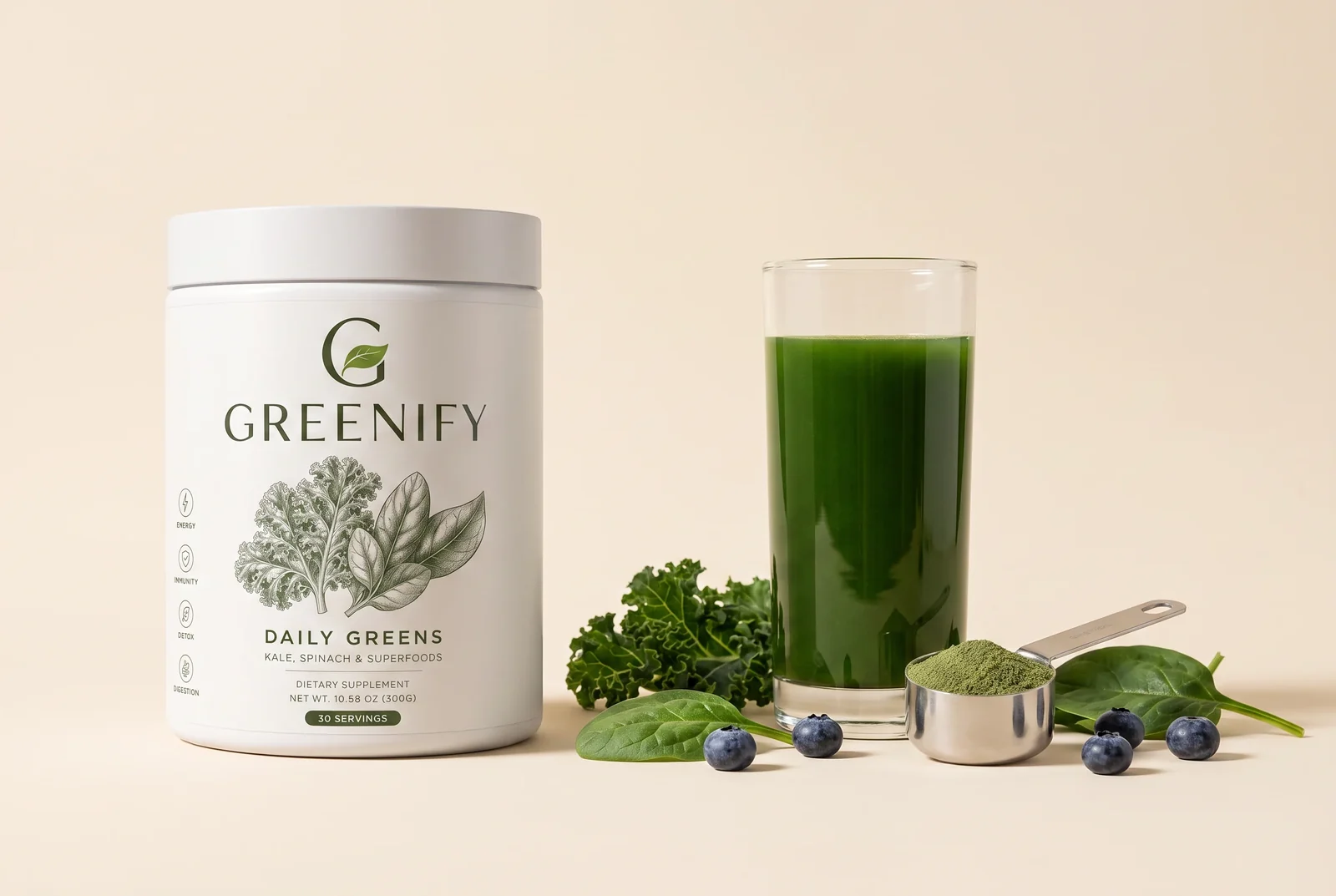
A 4.4g scoop with the blend weights printed on it
56 ingredients, 2.5B CFU across four named strains, five enzymes and three adaptogens — $1.40–$2.33 a day, no subscription, 60-day money-back guarantee.
Frequently asked questions
- Is Bloom or Organifi better for bloating?
- Neither product can be promised to relieve bloating, and no greens powder should be sold that way. Structurally, Bloom includes a digestive enzyme blend and probiotic content in its scoop while Organifi Green Juice includes neither as of August 2026, so Bloom is the one built with digestive support in the formula. If bloating is persistent, that is a conversation for a clinician rather than a supplement choice.
- Is Organifi worth twice the price of Bloom?
- It is if organic sourcing, printed blend weights and a disclosed 600mg ashwagandha dose are what you are buying. It is not if you mainly want a pleasant daily greens drink with enzymes included, which Bloom delivers at roughly $1.04 a serving.
- Do Bloom and Organifi both use proprietary blends?
- Yes. Both rely on proprietary blends, so neither publishes individual ingredient doses. Organifi discloses its two blend weights (5.1g and 1.45g) and its 600mg ashwagandha, which makes it the more legible of the two without fully solving the problem.
- Which one tastes better?
- That depends on your preference rather than a measurable standard. Bloom offers the widest range of sweet fruit flavors in the category; Organifi offers one mint-forward profile sweetened with monk fruit that is well regarded for masking herbal bitterness.