Nutrition
Greens Powder vs. Multivitamin: What's Actually Different
Last updated: February 2026
One delivers isolated nutrients at precise doses. The other delivers whole-food inputs, fiber, enzymes and cultures. Here's how to choose — and why plenty of people use both.
Greenify Editorial • February 6, 2026 • 5 min read
Written and fact-checked by the Greenify nutrition team against product labels and published nutrition guidance. Our editorial standards
- Comparison
- Labels
- Daily Greens
- Vitamins
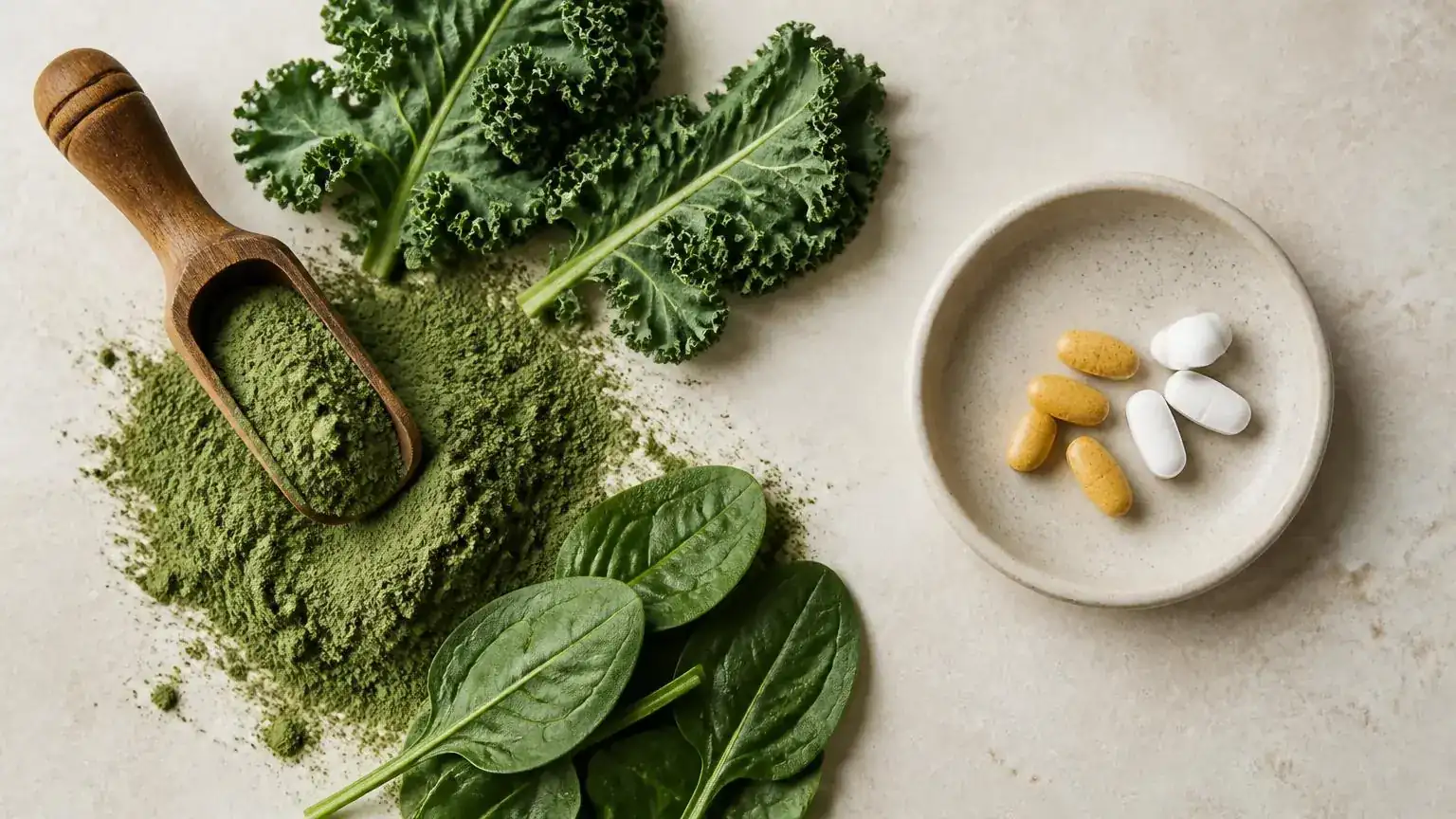
Greens powder vs multivitamin gets asked as if it were a straight swap. It is not. Whether you search it as green powder vs multivitamin or the plural, the two products are built from different raw materials, aim at different gaps in a diet, and are worth comparing on their own terms. Fifteen minutes of label-reading is enough to tell which one your kitchen is actually missing.
Is a greens powder better than a multivitamin?
Neither is better in general — they fix different gaps. A multivitamin is better if your concern is a specific micronutrient shortfall like vitamin D, B12 or iron, because it delivers a verifiable dose cheaply. A greens powder is better if your gap is plant matter: polyphenols, fiber, digestive enzymes and live cultures that a tablet cannot carry.
Can you take a greens powder and a multivitamin together?
Yes, and plenty of people do. The two overlap mainly on vitamins and minerals, so check both panels for anything already well over 100% of the daily value — particularly fat-soluble vitamins A, D, E and K, and minerals like zinc and iron — and space them across the day if you prefer. A disclosed panel makes that arithmetic possible; a proprietary blend makes it guesswork.
See a disclosed formula
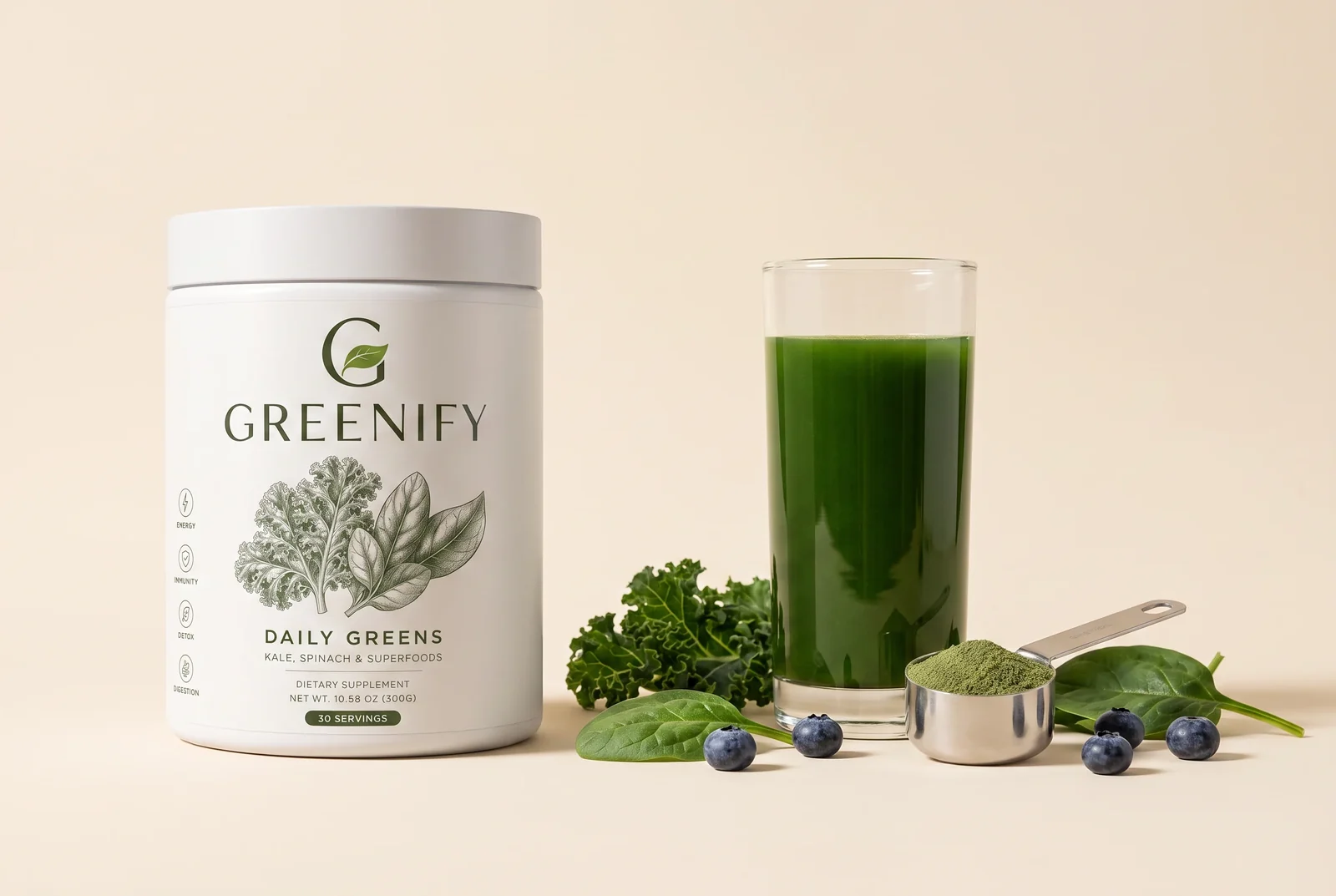
Every blend printed by weight
56 ingredients across four fully disclosed blends — so you can check the arithmetic instead of trusting the front of the tub.
They are not the same product category
A multivitamin is built around a list of isolated vitamins and minerals at defined percentages of daily value. Its job is coverage. Someone decided which twenty-odd micronutrients a typical diet most often misses, and the tablet delivers them at doses you can read off the panel and verify.
A greens powder is built around whole-food and botanical inputs — leafy greens, sea vegetables, berries, mushrooms, adaptogens — usually with supporting cast members like prebiotic fiber, digestive enzymes and live cultures. Its job is breadth of plant matter, not precision dosing of twenty-three micronutrients.
Conflating them causes two predictable mistakes. People take a greens powder expecting it to fix a diagnosed vitamin D deficiency, which it will not. And people take a multivitamin expecting it to substitute for vegetables, which it also will not, because a tablet carries almost none of what makes vegetables useful beyond their vitamin content.
What each format is genuinely good at
Multivitamins win on precision and price. If bloodwork shows you are low in vitamin D, B12 or iron, a targeted dose is the direct, cheap, measurable answer, and a greens powder is a roundabout one. Isolated nutrients are also easy to standardise, which makes quality control comparatively straightforward.
Greens powders win on everything a dry-pressed tablet cannot physically carry: polyphenols and phytonutrients from dozens of plants, fermentable fiber that feeds gut bacteria, enzymes that support digestion, and live cultures that rarely survive in tablet form. They also win on behaviour — a drink you make each morning tends to become a ritual in a way a pill in a drawer does not.
There is a cost difference, and it is real. A supermarket multivitamin might run ten to fifteen cents a day. A serious greens powder runs one to three dollars a day. Whether that is worth it depends entirely on what you are replacing: if the honest alternative is no vegetables at all, the maths looks different than if you already eat six servings.
Absorption is the other axis worth mentioning, because it is where the marketing gets loosest. Nutrients in a liquid are not magically better absorbed than nutrients in a tablet — bioavailability depends on the specific compound, the form it is in and what you eat alongside it. Folate as methylfolate and iron as bisglycinate are better absorbed than their cheaper counterparts whether they arrive as powder or pill. Where a powder does have a genuine edge is with fiber and live cultures, which simply cannot be compressed into a small tablet in useful quantity.
Read the back of the tub, not the front
Ignore the ingredient count on the front of the package. Seventy-five superfoods sounds impressive until you notice they are all inside one undisclosed one-gram proprietary blend, which works out to roughly thirteen milligrams each — a rounding error dressed up as a formula.
What you want is disclosure at the blend level or better. Greenify Daily Greens prints each of its four blends by weight: a 2.6g superfood, antioxidant and mushroom blend, 1.2g of herbs and extracts, 406mg of prebiotic fiber with five digestive enzymes, and a 2.5 billion CFU probiotic blend. That lets you do the arithmetic yourself instead of trusting an adjective.
Apply the same scepticism to multivitamins. Percentages far above 100% are not automatically better, particularly for fat-soluble vitamins, and a long tail of trace minerals at 2% DV is label decoration. Look for a facility statement, allergen disclosure and a serving size that matches the claim on the front.
So which one should you buy?
If you eat few vegetables and want a single habit that moves several things at once — plant variety, fiber, digestive support — start with a greens powder. It addresses the deficit you actually have, which is plant matter, not milligrams.
If your diet is already varied and your main worry is a specific gap you cannot close with food — vitamin D through a northern winter, B12 on a plant-based diet — buy the single nutrient and save the difference. Precision is cheap; breadth is not.
If you have a known, specific deficiency or a dietary restriction that reliably produces one — vegan diets and B12, limited sun exposure and vitamin D, heavy menstrual bleeding and iron — take the targeted nutrient. Do not ask a greens powder to be a therapy.
Plenty of people sensibly do both, and they are not competing purchases. If budget forces a choice, pick the one that fixes your actual gap, and remember that neither product outperforms simply eating more plants. Supplements are named for what they do: supplement.
The takeaway
A multivitamin is precision insurance against specific shortfalls. A greens powder is broad whole-food coverage — plant compounds, fiber, enzymes and cultures that a tablet was never designed to carry. Neither one makes the other pointless, and both lose to vegetables you actually eat.
If you want one habit that does the most work, read the back of the tub: look for disclosed blend amounts, a stated CFU count, and no proprietary fog. Daily Greens discloses all four of its blends, which is the standard you should hold any greens powder to.