
Gut Health
Prebiotics, Probiotics and Enzymes: How They Work Together
Last updated: March 2026
Probiotics are the seeds. Prebiotics are the soil. Taking one without the other is half a strategy — here's how the pairing actually works.
Greenify Editorial • March 11, 2026 • 6 min read
Written and fact-checked by the Greenify nutrition team against product labels and published nutrition guidance. Our editorial standards
- Probiotics
- Prebiotic fiber
- CFU
- BioVive
Three words show up together on gut-health labels — probiotics, prebiotics, enzymes — and almost nobody explains how they divide the work. One supplies organisms, one feeds them, one helps you break down the meal in front of you. Here is what each part does and why a formula that includes all three is doing something a single-ingredient capsule cannot.
Two halves of one system
A probiotic supplies live organisms — typically species of Lactobacillus and Bifidobacterium — measured in colony-forming units, the count of viable cells capable of multiplying. A prebiotic is a fermentable fiber, such as inulin from chicory root, that your resident bacteria break down for fuel. Together they are sometimes called a synbiotic, which is just a formal way of saying seeds plus soil.
Deliver bacteria with nothing to eat and you are relying entirely on what is already on your plate to sustain them. Deliver fiber into a depleted, low-diversity microbiome and you may notice the gas before you notice the benefit. The pairing exists because each half compensates for the other's weakness.
The bacteria that matter are not passive passengers. When they ferment fiber they produce short-chain fatty acids — butyrate, propionate, acetate — which are the primary fuel for the cells lining your colon. That is the mechanism most gut-health claims are gesturing at, whether or not the label says so.
Fermented foods such as yogurt, kefir, sauerkraut and kimchi deliver live organisms too, though usually as an undefined mixture of strains at an unlabelled count. Food-first is a perfectly good strategy; a supplement's advantage is that you know exactly what is in it.
CFU is a specification, not a score
A 50 billion CFU single-strain product is not automatically better than a 5 billion CFU seven-strain product. Different strains do measurably different things, and clinical research is generally strain-specific rather than genus-specific — Lactobacillus rhamnosus GG is not interchangeable with any other Lactobacillus just because they share a first name.
The count only matters if the organisms are still viable when you swallow them and can survive stomach acid on the way down. That depends on the strains chosen, the manufacturing process, moisture control, packaging and whether the CFU number is guaranteed at expiry or merely at time of manufacture. A huge number guaranteed at manufacture is a marketing number.
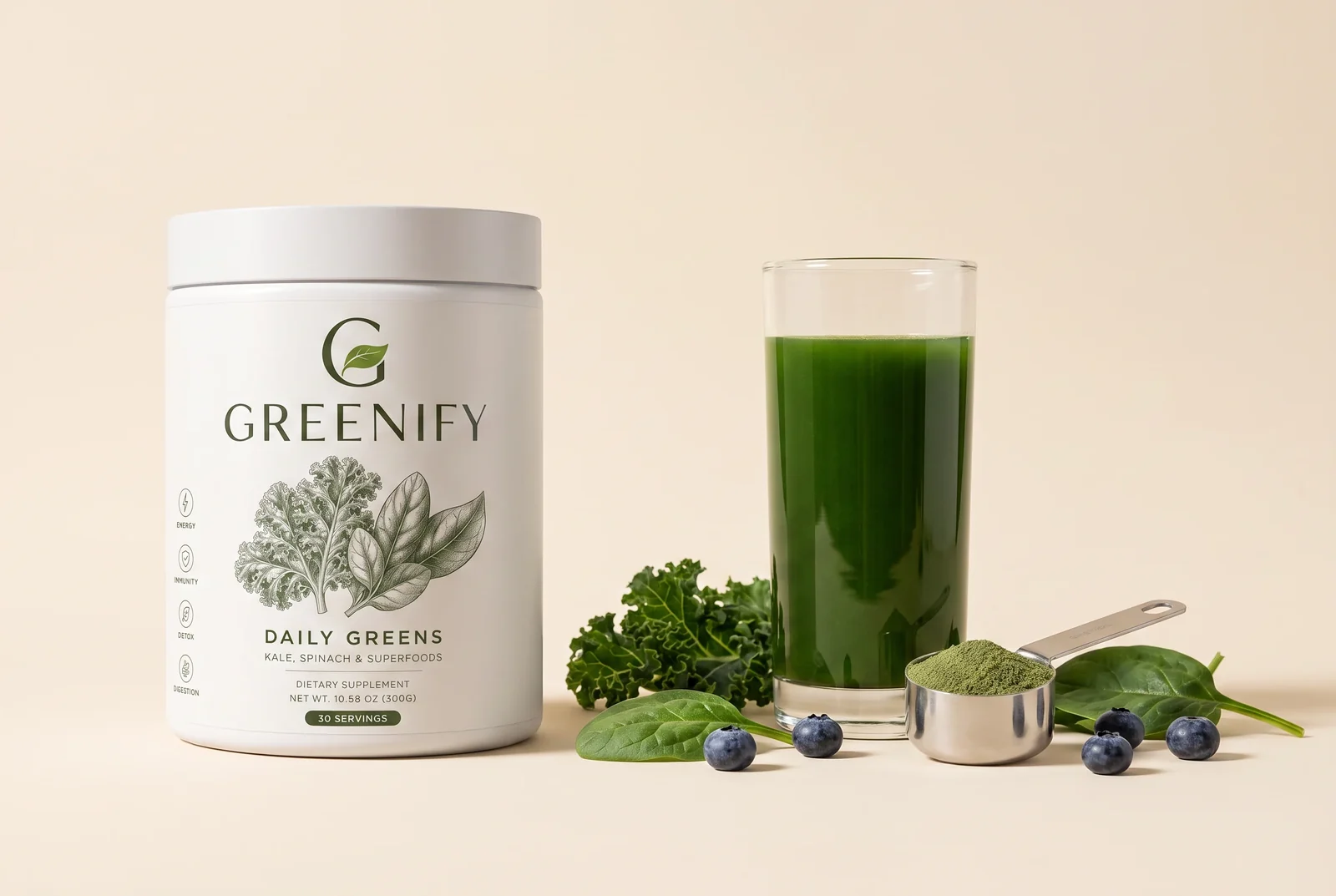
BioVive uses 5.75 billion CFU across seven strains in a capsule format. Daily Greens carries a smaller 2.5 billion CFU blend, but pairs it with 406mg of prebiotic fiber and five digestive enzymes — which is precisely the combination that makes a modest culture count useful rather than ornamental.
Build the pairing
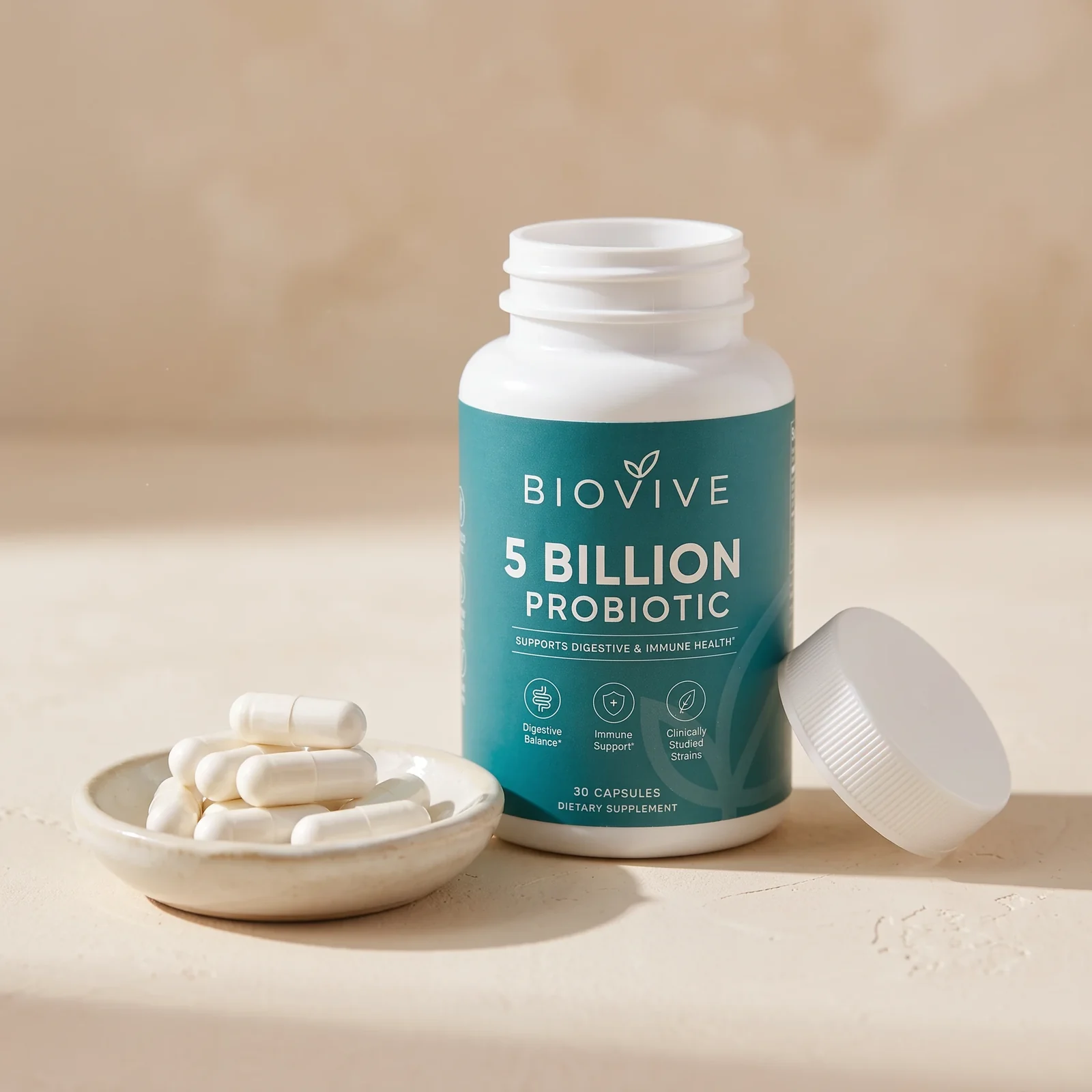
BioVive: 5.75 billion CFU across seven strains
A once-daily capsule for digestive and immune support — and Daily Greens supplies the 406mg of prebiotic fiber and five enzymes that make the pairing a strategy rather than half of one.
Where prebiotics come from
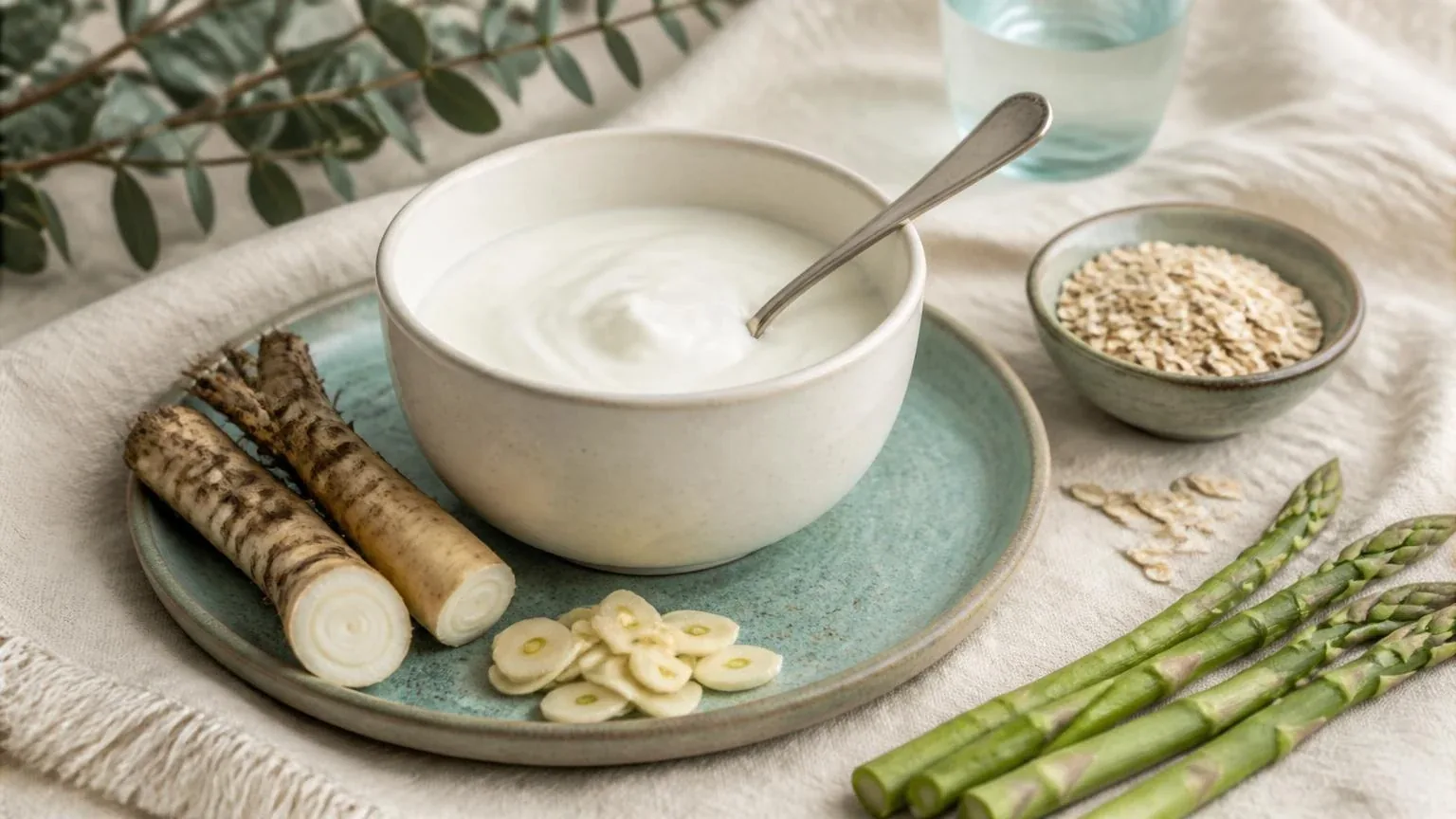
You do not have to buy prebiotics to get them. Chicory root, garlic, onions, leeks, asparagus, slightly green bananas, oats, barley and cooled cooked potatoes or rice all deliver fermentable fiber, and a varied plant-heavy diet is the most robust prebiotic strategy there is.
Supplemental prebiotics are useful for the same reason supplemental anything is useful: consistency. Inulin, fructooligosaccharides (FOS) and galactooligosaccharides (GOS) are the common forms, and a few hundred milligrams to a few grams daily is a typical supplemental range — well below the twenty-five to thirty-eight grams of total daily fiber most adults should be aiming at from food.
Starting without the bloat
Fermentable fiber produces gas. That is the mechanism working, not a defect in the product, and it is the single most common reason people quit in week one. If you are new to it, start at half a serving for the first week, take it with food, and drink plenty of water. Most people settle within seven to fourteen days.
Consistency beats intensity. A daily modest dose does more for microbial composition than an occasional heroic one, and the research protocols that show change generally run for weeks. Take it at the same time each day so you stop deciding.
A few people should get advice first: anyone who is immunocompromised, has an indwelling catheter or central line, has recently had gastrointestinal surgery, or has SIBO or a diagnosed FODMAP intolerance, for whom fermentable fiber can be genuinely uncomfortable. And if a course of antibiotics is involved, ask your prescriber about timing rather than guessing.
Finally, be sceptical of anything promising to "reset" or "heal" your gut on a fixed schedule. The microbiome is responsive but not obedient: diet shifts composition within days, those shifts largely revert when the diet does, and no supplement rebuilds an ecosystem in a fortnight. The durable inputs are boring and cumulative — more plant variety, more fiber, enough sleep, less unnecessary antibiotic exposure — with a probiotic as a useful addition rather than the whole plan.
Where enzymes fit in
Enzymes are the third part of the picture and the most often skipped. Probiotics and prebiotics work on your microbiome; digestive enzymes work on the food itself, helping break down specific macronutrients — protease for protein, amylase for starch, lipase for fat, cellulase for plant fiber, lactase for milk sugar — before fermentation ever becomes the question.
That is why Daily Greens includes five enzymes alongside its 406mg of prebiotic fiber. A greens powder is a concentrated dose of plant material arriving all at once, and enzyme support is there to help make that a comfortable habit rather than an ambitious one. If dairy or legumes are what reliably bother you, an enzyme is the piece of the puzzle a probiotic was never going to solve.
The takeaway
Probiotics supply organisms, prebiotic fiber feeds them, and digestive enzymes work on the meal itself. The three support different steps, which is why the combination tends to be more useful than any of them alone.
Start at half a serving, take it with food and water, and give it two weeks before judging it. BioVive covers the culture side at 5.75 billion CFU across seven strains; Daily Greens supplies 406mg of prebiotic fiber plus five enzymes and a 2.5 billion CFU blend.