


Energy
MCT Oil: C8 and C10 for Clean Ketogenic Energy
Last updated: June 2026
MCTs take a shortcut most dietary fats cannot. Here's the actual biochemistry, what C8 and C10 mean on a label, and how to start without wrecking your morning.
Greenify Editorial • June 9, 2026 • 5 min read
Written and fact-checked by the Greenify nutrition team against product labels and published nutrition guidance. Our editorial standards
- MCT
- Keto
- Metabolism
- Diet Accelerator

MCT oil sits in a strange spot: genuinely interesting biochemistry, wrapped in some of the loudest claims in the supplement aisle. The interesting part is real — a class of fats your body routes differently from every other fat you eat. Here is how C8 and C10 work, what they can reasonably support, and how to take them without regretting it.
What makes a fat 'medium-chain'
Dietary fats are classified by the length of their carbon chain. Long-chain triglycerides — the majority of fat in most diets, from olive oil to steak — run thirteen to twenty-one carbons. Medium-chain triglycerides run six to twelve: C6 caproic, C8 caprylic, C10 capric and C12 lauric. Coconut and palm kernel oil are the main dietary sources, and coconut is where most supplemental MCT oil originates.
Chain length is not trivia; it changes the route of absorption. Long-chain fats need bile salts and pancreatic lipase, get packaged into chylomicrons, and travel through the lymphatic system before ever reaching general circulation. Medium-chain fats are largely absorbed directly into the portal vein and delivered to the liver, and they need little to no bile to do it.
That shortcut is the entire reason MCTs exist as a category. It is also why they were used clinically for decades — in fat malabsorption, pancreatic insufficiency and certain paediatric conditions — long before anyone put them in a coffee.
It also explains the speed people describe. Because medium-chain fats skip the lymphatic detour and need little bile, they reach the liver within roughly half an hour of ingestion rather than the several hours a fatty meal takes to enter circulation. Whether that registers as a subjective lift varies from person to person, but the pharmacokinetics behind the claim are real and well characterised.
C8, C10 and the ketone question
Once in the liver, medium-chain fatty acids can be rapidly oxidised, and a portion is converted into ketone bodies — beta-hydroxybutyrate and acetoacetate — which circulate as an alternative fuel that the brain and muscles can use. This happens to a degree even when you are eating carbohydrates, which is what distinguishes MCTs from simply being on a ketogenic diet.
Not all MCTs are equal at this. C8 (caprylic acid) is the most efficiently ketogenic, converting quickly with the least metabolic fuss. C10 (capric acid) is close behind. C12 (lauric acid) behaves in some respects more like a long-chain fat and raises blood ketones far less, which is why a label boasting about coconut oil content is not making the same claim as one specifying C8 and C10 content.
Read labels accordingly. "MCT oil" can legally mean a C8/C10 blend or a cheaper preparation heavy in C12. Diet Accelerator is built on 2000mg of MCT oil in a softgel, which is the format that removes the two practical objections to liquid oil: taste and dosing mess.
Skip the oily spoon
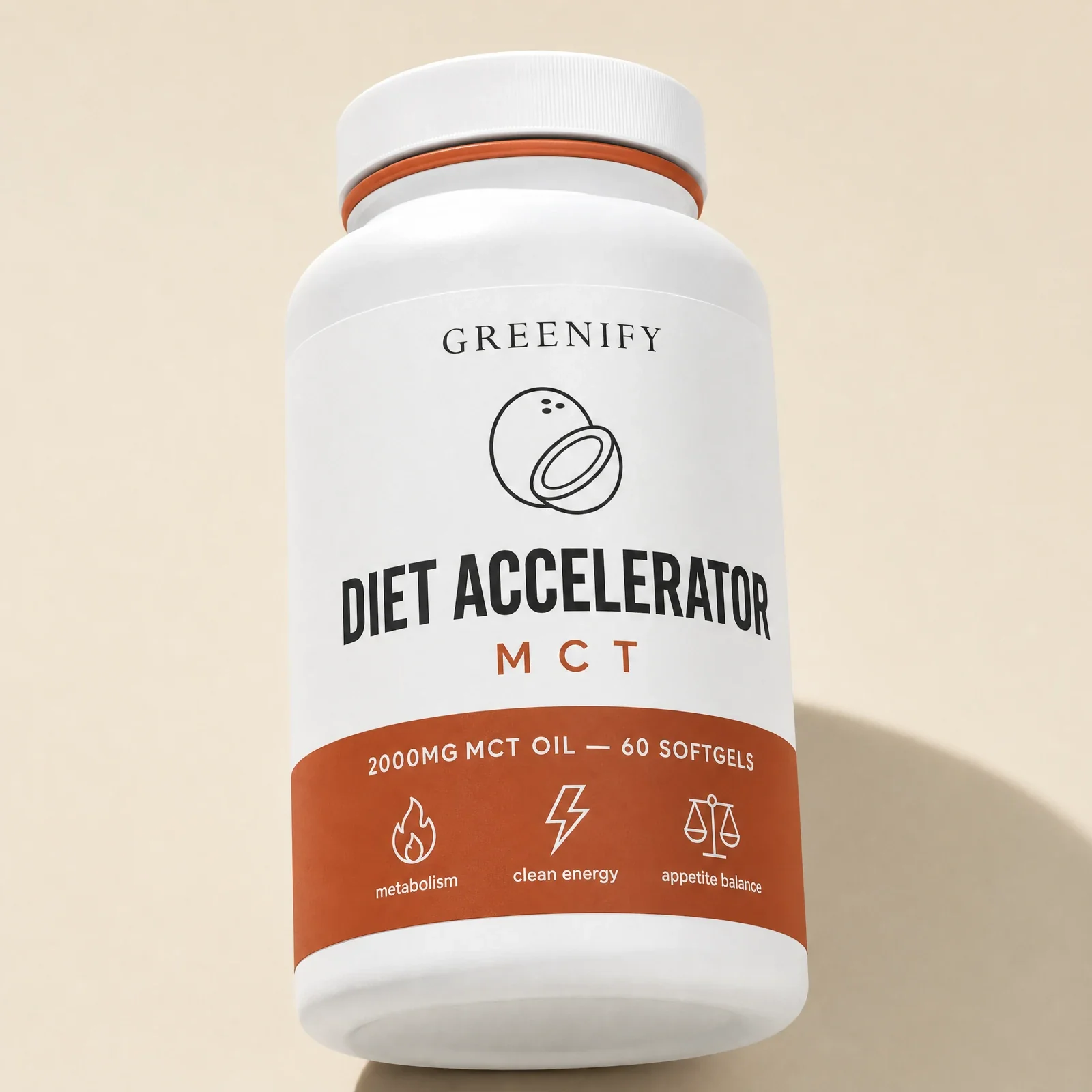
Diet Accelerator: 2000mg MCT in a softgel
A calm, stimulant-free MCT softgel for people who want metabolism and clean ketogenic energy support without measuring oil into a coffee cup. Take it with a meal containing fat.
What MCTs realistically do
The best-supported effects are metabolic and modest. MCTs are more rapidly oxidised than long-chain fats, they raise blood ketones in a dose-dependent way, and controlled trials have found small effects on energy expenditure and satiety relative to equivalent long-chain fat. Some appetite research suggests people eat slightly less at subsequent meals.
What they are not is a substitute for a calorie deficit. MCT oil is roughly 8.3 calories per gram — it is fat, and adding a tablespoon to a diet without removing anything adds around 115 calories. The sensible framing is substitution: MCTs replacing other dietary fats, not stacking on top of them.
For people following a ketogenic diet, MCTs are a genuinely useful tool for smoothing the adaptation period and topping up ketones. For everyone else they are a fast-access fat with mild appetite and thermogenic effects. Both of those are real; neither is dramatic.
One more caveat on the mental-clarity claim, since it is the most-repeated one. Ketones are a usable brain fuel, and raising them does change substrate availability — but in healthy, well-fed adults glucose is not in short supply, so there is nothing obvious to rescue. The clearest cognitive findings come from populations with impaired glucose metabolism. If you feel sharper on MCTs, that is a legitimate personal observation; it is not a demonstrated general effect.
Dosing, timing and cautions
Start low. The universal beginner mistake is a full tablespoon of liquid MCT oil on an empty stomach, and the result — cramping and urgent bathroom trips, sometimes called disaster pants in keto forums — is a tolerance issue, not an allergy. Begin with a teaspoon or a single softgel, take it with food, and build up over a week or two.
Timing depends on the goal. Morning use with coffee is the most popular pattern and suits people chasing steady energy through the first half of the day. Pre-workout use twenty to thirty minutes ahead suits endurance sessions. Fat-soluble ingredients generally sit better with a meal containing some fat.
Cautions are short but worth respecting. People with liver disease should avoid MCT supplementation without medical supervision, because the liver does the metabolic work. Anyone with gallbladder issues, diabetes managed with insulin, or a history of pancreatitis should ask a clinician first. And as with any supplement: this is education, not medical advice, and it does not treat or cure anything.
The takeaway
C8 and C10 are medium-chain fats your body absorbs and converts quickly, which is why they support clean energy and ketone production without the stimulant load of caffeine. They are a fuel source and a useful tool on a low-carb or fasted routine — not a substitute for the diet doing the work.
Start low, always take them with food for the first few days, and build up. Diet Accelerator delivers 2000mg of MCT oil in a two-softgel serving, which is a far easier way to be consistent than measuring oil from a spoon.