
Comparisons
Cheaper AG1 Alternatives: What You Actually Save
Last updated: August 2026
AG1 costs $79 a month on subscription or $99 one-time. Here is what seven cheaper AG1 alternatives actually cost per month and per day — and what you give up at each price.
Greenify Editorial • July 20, 2026 • 7 min read
Written and fact-checked by the Greenify nutrition team against product labels and published nutrition guidance. Our editorial standards
- Comparison
- AG1
- Cost
- Daily Greens

Most people searching for a cheaper alternative to AG1 want one number: what will this cost me a month instead of $79? So the cost table comes first in this guide, then the trade-offs behind each price. AG1 runs $79 a month on subscription or about $99 for a one-time 30-serving purchase — roughly $2.63 to $3.30 a day. Every alternative below is cheaper than that, but they are not cheaper in the same way: some cut the ingredient list, some cut the disclosure, and some just cut the marketing budget. This guide shows the arithmetic, then what you actually give up at each price point, including the places our own product loses.
What is the best AG1 alternative?
For most shoppers the best AG1 alternative is the cheapest one that still prints its doses. Greenify Daily Greens fits that description at $69.95 a month ($2.33 a day, or $1.40 on the 5-tub bundle) with all four blend weights on the panel. If price alone is the goal, Amazing Grass at $24.99 a month is the cheapest credible option, with a far shorter formula.
What is a cheaper alternative to AG1?
Every option in the table below is cheaper than AG1's $79 monthly subscription. Bloom ($39.99), Jocko Greens ($49.95), Live it Up ($49.99) and Huel Daily Greens (about $45) all land under $50 a month. Amazing Grass is cheapest at $24.99. Greenify Daily Greens and Organifi sit at $69.95 — about $10 a month less than AG1, with no subscription required.
See the panel first
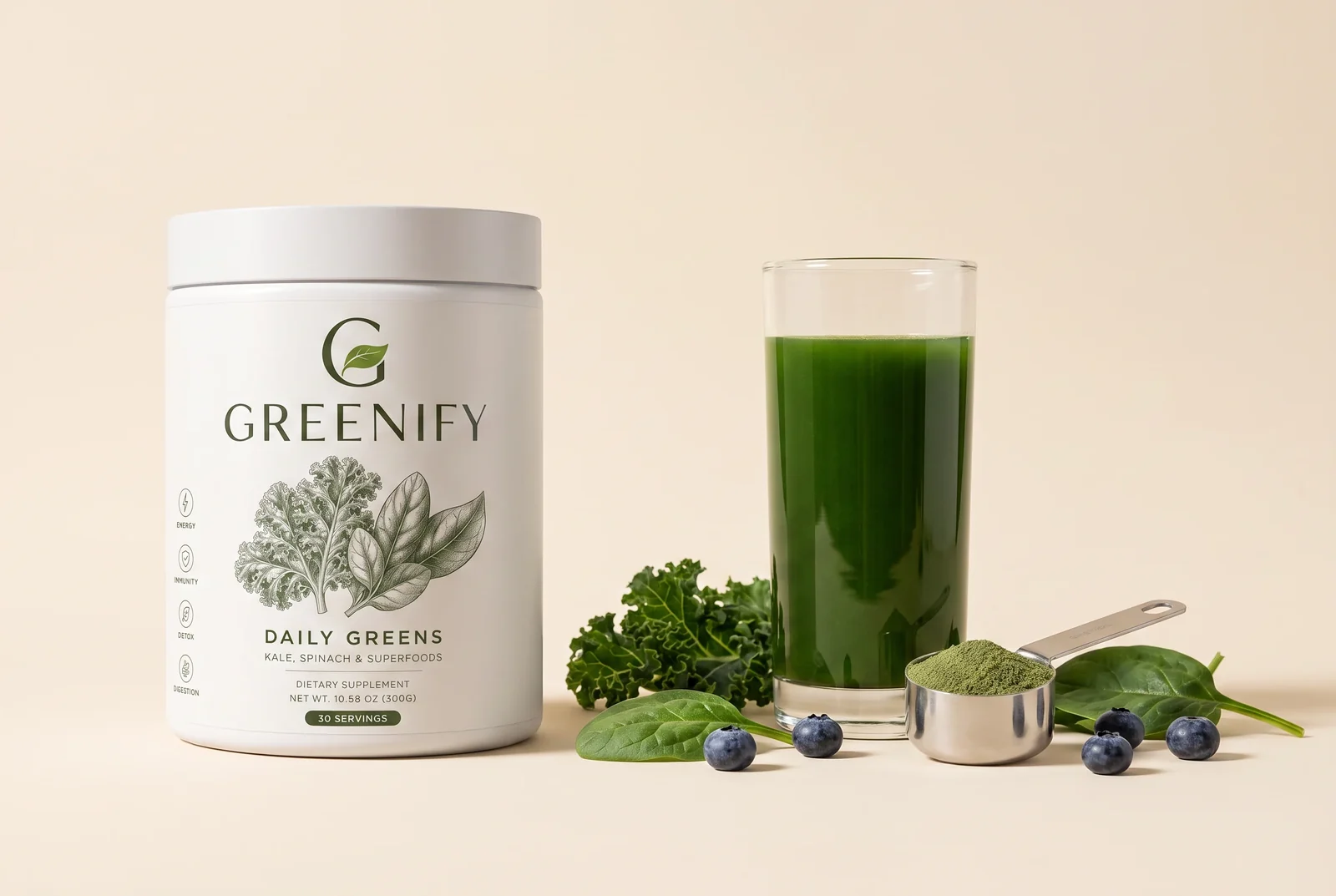
Every blend weight printed on the tub
56 ingredients across four disclosed blends, 2.5 billion CFU, five named enzymes and stevia as the only sweetener — from $1.40 a day, with 60 days to change your mind.
Why is AG1 so expensive?
AG1's price reflects breadth, operations and marketing rather than one costly ingredient: roughly 75 ingredients, 10 billion CFU of probiotics, third-party banned-substance testing, premium packaging, and heavy podcast and athlete sponsorship spend. Those costs are real, but a large share of the $79 buys distribution and brand rather than grams in the scoop.

Cheaper AG1 alternatives compared by cost
Monthly prices are each brand's own published direct price for a 30-serving container as of August 2026, and per-day cost is that price divided by 30 servings. AG1 appears twice because its subscription and one-time prices differ materially.
| Product | Price (30 servings) | Per day | Saving vs AG1 subscription |
|---|---|---|---|
| AG1 — subscription | $79.00 | $2.63 | — |
| AG1 — one-time | ~$99.00 | ~$3.30 | +$20.00 more |
| Greenify Daily Greens — single tub | $69.95 | $2.33 | $9.05 less |
| Greenify Daily Greens — 3+2 bundle | $41.97 per 30 servings | $1.40 | $37.03 less |
| Organifi Green Juice | $69.95 | $2.33 | $9.05 less |
| Live it Up Super Greens | $49.99 | $1.67 | $29.01 less |
| Jocko Greens | $49.95 | $1.67 | $29.05 less |
| Huel Daily Greens | ~$45.00 | ~$1.50 | ~$34.00 less |
| Bloom Greens & Superfoods | $39.99 | $1.33 | $39.01 less |
| Amazing Grass Green Superfood | $24.99 | $0.83 | $54.01 less |
What AG1 does well, plainly
It is worth starting here, because most comparison content skips it and loses the reader's trust in the first paragraph. AG1 essentially created the modern all-in-one greens category, and it is a competent product. The formula runs to roughly 75 ingredients spanning greens, fruits, mushroom and herb extracts, vitamins, minerals, prebiotic fiber, digestive enzymes and a probiotic component listed at 10 billion CFU. That CFU number is genuinely higher than most greens powders carry, ours included.
The operational side is strong too. AG1 is produced to recognised manufacturing standards, carries third-party testing for banned substances that matters to competitive athletes, and ships in packaging and a subscription rhythm that removes almost all friction from the habit. The company also updates the formula periodically rather than freezing it, which is more than most of the category bothers to do. If somebody tells you AG1 is a scam, they are overstating things considerably.
Its guarantee is also longer than ours: 90 days versus our 60. We would rather write that sentence than have you find it out later.
So the honest framing is not that AG1 is bad. It is that AG1 is a premium, broad, largely undisclosed formula sold at a premium price, and that a meaningful share of people want a different set of trade-offs.
Why people go looking for an alternative
The first reason is arithmetic. At roughly $79 per month on subscription — or about $99 for a one-time purchase — a daily greens habit lands somewhere between $2.60 and $3.30 a day. Over a year that is a few hundred dollars for one line item in a supplement routine. For a lot of households, the powder is not the problem; the annual total is.
The second reason is the label. Most of AG1's ingredients sit inside proprietary blends, where the law requires the total weight of the blend and the ingredients in descending order, but not the amount of each one. That is entirely legal and extremely common. It also means that if you want to know whether you are getting a meaningful amount of ashwagandha or a pinch of it, the panel will not tell you. When a formula lists 75 ingredients inside a fixed total gram weight, simple division tells you that many of them are present in small amounts — the open question is which ones.
The third reason is the subscription itself. Auto-ship is a convenience for people who want a locked-in habit and an irritation for people who want to buy three tubs and stop thinking about it. Neither preference is wrong; they are just different, and one of them is poorly served by a subscription-first brand.
A fourth, quieter reason: taste and tolerance. Greens powders are strongly flavoured and individually variable. If a formula does not agree with you, no amount of ingredient count fixes that, and switching is reasonable.
How to judge an alternative without getting burned
Start with disclosed blend weights. A label that prints the gram weight of each blend — and ideally the milligram weight of the headline actives — is telling you something a 75-ingredient list cannot. Ingredient count is a marketing metric; dose is a formulation metric. Given a choice between forty disclosed ingredients and eighty undisclosed ones, the disclosed panel is the more informative purchase.
Next, look at what fills the tub. Serving sizes in this category run from about 4g to 12g. A large scoop is not automatically better — much of the weight can be fiber, flavour system or fruit powder — and a small scoop is not automatically weak. Read the first three ingredients in each blend, since ingredients are listed in descending order by weight, and see whether the things you are buying the product for appear near the top or near the bottom.
Then check the live components. Probiotic CFU should be stated per serving with a guarantee through the expiry date rather than at time of manufacture. Digestive enzymes should be named individually. Prebiotic fiber should have a source. If a formula claims gut support and lists none of the three, it is a greens powder with a gut-health headline.
Finally, do the per-day arithmetic in front of you, not the per-tub price. Divide the total cost by the number of servings, not the number of days you intend to use it. And check the return policy before ordering rather than after: a category built on subjective taste and slow-building benefits should carry a real money-back window.
Where Greenify Daily Greens fits
We built Daily Greens around one decision: print the doses. The 4.4g scoop is organised into four blends whose weights appear on the panel — a 2.6g superfood, antioxidant and mushroom blend of 34 whole-food ingredients; 1.2g of nutrient-dense herbs and extracts including ashwagandha, Korean ginseng and eleuthero; 406mg of prebiotic fiber with five named digestive enzymes; and a probiotic blend of four strains at 2.5 billion CFU. Fifty-six ingredients in total, with the vitamin and mineral contributions declared as percentage daily values: 148% DV Vitamin C, 1042% DV Vitamin B12, 427% DV Vitamin E, 74% DV Zinc.
The pricing is deliberately un-clever. One tub of 30 servings is $69.95, which is $2.33 per day. The 2+1 bundle is $139.90 for 90 servings, or $1.55 a day. The 3+2 bundle is $209.85 for 150 servings, which works out at $1.40 a day. There is no subscription requirement and no member pricing tier — the bundle price is the price, and multi-packs ship free.
We will not pretend this is a clean sweep. AG1 carries four times our probiotic CFU and a longer list of ingredients, and its 90-day guarantee beats our 60. If maximum breadth and the highest CFU number are what you are optimising for, that is a legitimate reason to stay where you are.
| Greenify Daily Greens | AG1 | |
|---|---|---|
| Cost per day | $1.40–$2.33 | ~$2.60–$3.30 |
| One-time purchase | $69.95 (30 servings) | ~$99 (30 servings) |
| Subscription required for best price | No — bundles, no auto-ship | Yes — subscription pricing |
| Ingredients | 56 | ~75 |
| Blend weights printed | Yes — all four blends | Largely proprietary blends |
| Probiotic CFU | 2.5 billion, 4 strains | 10 billion |
| Digestive enzymes | 5, named individually | Included |
| Sweetener | Stevia leaf extract only | Stevia |
| Serving size | 4.4g | 12g |
| Guarantee | 60 days | 90 days |
The takeaway
If your reason for shopping alternatives is that you want the biggest ingredient list and the highest CFU count on the shelf and the price is not the deciding factor, AG1 remains a strong product and there is no need to switch. That is a perfectly rational place to land.
If your reason is that you want to see the doses you are paying for, own your supply outright rather than manage a subscription, and cut the daily cost roughly in half, that is precisely the gap Daily Greens was built for. Read both panels side by side before you decide — the labels will tell you more in five minutes than any comparison article, this one included.