Comparisons
Why Is AG1 So Expensive? A Cost Breakdown (2026)
Last updated: August 2026
AG1 is $79 a month on subscription and about $99 one-time. Some of that is genuine cost — breadth, testing, operations — and some of it is the price of being the most advertised greens powder in the world.
Greenify Editorial • August 9, 2026 • 8 min read
Written and fact-checked by the Greenify nutrition team against product labels and published nutrition guidance. Our editorial standards
- AG1
- Cost
- Comparison
- Greens powder
AG1 costs $79 a month on subscription, or about $99 for a single 30-serving purchase — roughly $2.63 to $3.30 per scoop. That is two to three times what several competent greens powders charge, which is why 'why is AG1 so expensive' is one of the most-searched questions in the category. The honest answer has four parts: a genuinely broad formula, real third-party testing, premium packaging and logistics, and an advertising budget that is unusually large even by direct-to-consumer standards. This is a cost breakdown, not a hit piece — AG1 is a competent product, and some of what you pay for is real.
How much does AG1 actually cost?
AG1's published pricing has two tiers. The subscription price is $79 for a 30-serving supply, which works out at $2.63 a serving. A one-time purchase of the same quantity runs about $99, or $3.30 a serving. Over a year, daily use costs roughly $948 on subscription and about $1,188 if you buy one-time each month.
The gap between those two numbers is itself part of the answer to the cost question. AG1's model is built around recurring revenue: the subscription price is the real price, and the one-time price exists partly to make the subscription look like the sensible choice. That is a common and legal pricing structure, but it means the cheapest way to buy AG1 requires a plan you have to remember to manage.
For context, the median published price across the eight greens powders we track is closer to $55 for 30 servings. AG1 sits well above that, and the one-time price sits above every other product in the category we have compared.
What drives the cost of a greens powder?
Four things drive price in this category, and only one of them is the powder itself. The first is ingredient breadth and quality. AG1 lists roughly 75 ingredients including mushroom and herb extracts, a 10 billion CFU probiotic component and a full vitamin and mineral profile. Standardised botanical extracts and viable probiotic cultures cost meaningfully more per gram than grass powders and fruit fibers, and a 12g scoop uses more raw material than a 4g one.
The second is testing and compliance. AG1 carries third-party banned-substance certification, which matters to anyone in drug-tested competition and requires per-batch lab work that most greens powders skip entirely. That is a genuine cost line, and one of the clearest things you are paying for.
The third is packaging and logistics. Foil pouches, travel sticks, branded scoops, shakers and the unboxing experience all cost money, and subscription fulfilment adds per-shipment handling. None of it changes what happens in your body, but it does change what happens on your card.
The fourth is marketing, and in AG1's case it is unusually large. AG1 is one of the most heavily advertised supplements in the world — podcast sponsorships, athlete and practitioner partnerships, and affiliate commissions on a very wide scale. Customer acquisition of that intensity has to be recovered somewhere, and it is recovered in the retail price of every scoop.
What are you paying per serving?
Nobody outside the company can publish an audited cost breakdown of a scoop, and we are not going to invent one. What can be said honestly is which categories the money falls into, and the direction of magnitude. Across direct-to-consumer supplements broadly, raw material and manufacturing typically account for a minority of the retail price, while acquisition marketing, packaging, fulfilment, payment processing, returns and margin account for the majority. There is no reason to think AG1 is an exception, and its advertising presence suggests the marketing share is high rather than low.
Here is the more useful way to think about it as a buyer: what does the next-best product cost, and what would you lose? At $2.63 a serving on subscription, AG1 costs about $0.30 a day more than a $69.95 disclosed-dose formula and about $1.23 a day more than a $39.99 budget formula. Over a year that is roughly $110 and $450 respectively.
Those are the real stakes of the question. Not 'is AG1 a rip-off' — it is a legitimate product with real costs — but 'is the difference between AG1 and the alternative worth $110 to $450 a year to me?' For someone who needs banned-substance certification, or who specifically wants 10 billion CFU and the widest ingredient list, the answer can reasonably be yes.
| Product | 30 servings | Per serving | Annual cost at one a day |
|---|---|---|---|
| AG1 — subscription | $79.00 | $2.63 | ~$948 |
| AG1 — one-time | ~$99.00 | ~$3.30 | ~$1,188 |
| Greenify Daily Greens — single tub | $69.95 | $2.33 | ~$839 |
| Greenify Daily Greens — 3+2 bundle | $41.97 | $1.40 | ~$504 |
| Jocko Greens | $49.95 | $1.67 | ~$599 |
| Bloom Greens & Superfoods | $39.99 | $1.33 | ~$480 |
| Amazing Grass Green Superfood | $24.99 | $0.83 | ~$300 |
Is AG1 worth the money?
It is worth it for a narrow set of buyers, and hard to justify for everyone else. If you compete in a drug-tested sport, the third-party banned-substance testing is not a nice-to-have and very few competitors offer it. If you want the highest published probiotic count in a greens powder, AG1's 10 billion CFU beats most of the field, ours included. If a 90-day money-back window is what makes you willing to try the category at all, that is the longest guarantee published in the category.
It is harder to justify if your priority is knowing what you are actually taking. Most of AG1's ingredients sit inside proprietary blends, so the panel tells you the total weight and the descending order, not the amount of each item. When 75 ingredients share a fixed gram total, arithmetic says several of them are present in small amounts; the label just will not tell you which.
And it is hard to justify on cost alone if a cheaper product covers your actual gap. If what you want is more plant variety, some fiber and a daily habit you will keep, several products in the table above do that for a third to two-thirds of the price.
How to cut the cost without dropping the habit
If you like AG1 and just want to pay less for it, the subscription price is the lower of the two published prices, so a one-time buying pattern is the most expensive way to use the product. Buying in the rhythm the brand prices for saves about $20 a month against one-time purchases.
If you are willing to switch, the biggest single saving in the category comes from multi-pack pricing rather than from buying a cheaper formula. A 150-serving bundle at $209.85 works out at $1.40 a serving — less than half AG1's subscription rate — without dropping to a seven-ingredient formula.
And if cost is genuinely the binding constraint, be honest about what you need. A $24.99 grass-and-fruit powder plus a cheap, well-chosen multivitamin covers more ground for most people than an expensive all-in-one they abandon in month three because of the bill.
Publisher disclosure
Full disclosure: we make one too
This article is published by Greenify, and we sell a greens powder — Daily Greens. We have kept our own product out of the judgement calls above wherever we could, and where we do appear in a price table we appear at the same published prices anyone can check on our product page.
Our case, stated plainly: Daily Greens prints the weight of all four of its blends on the panel rather than pooling them into one proprietary total, carries 56 ingredients, 2.5 billion CFU across four named strains, five digestive enzymes and three adaptogens in a 4.4g scoop, costs $1.40–$2.33 a day with no subscription, and is covered by a 60-day money-back guarantee. AG1 carries four times our probiotic CFU and a 90-day guarantee, and several products in these tables cost less than we do. If either of those is what you are optimising for, buy accordingly.
Disclosed doses, no subscription
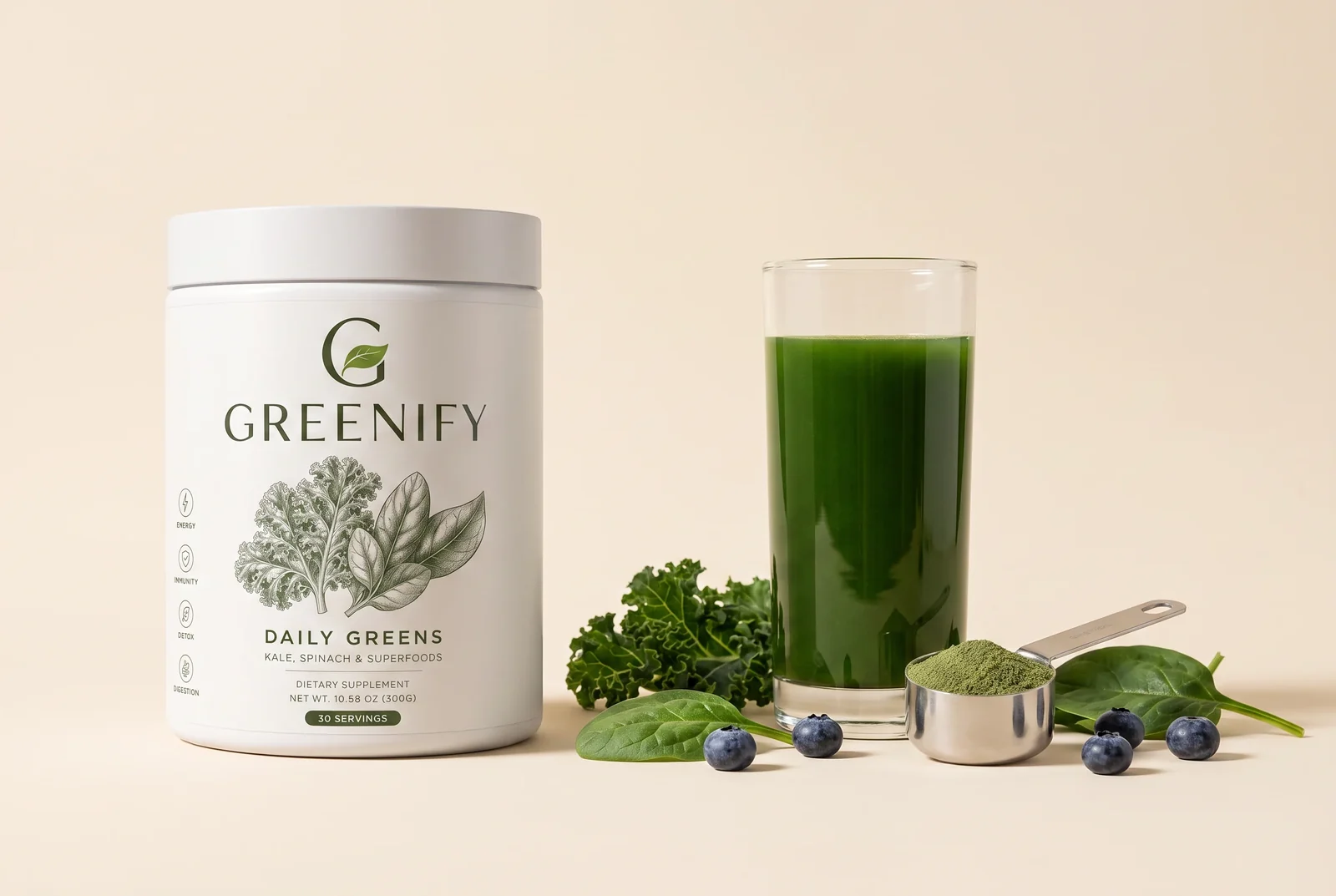
$1.40–$2.33 a day, every blend weight printed
Daily Greens puts 56 ingredients, five digestive enzymes and 2.5 billion CFU into a 4.4g scoop with all four blend weights on the panel — bought outright, not on a plan you have to cancel.
Frequently asked questions
- Why is AG1 so expensive?
- AG1's $79 monthly price reflects a broad 75-ingredient formula, 10 billion CFU of probiotics, third-party banned-substance testing, premium packaging and subscription logistics — plus one of the largest advertising budgets in the supplement category, which is recovered in the retail price.
- How much does AG1 cost per month?
- AG1 costs $79 a month on subscription for 30 servings, or about $99 for a one-time purchase of the same quantity — roughly $2.63 to $3.30 per serving.
- Is AG1 cheaper on subscription?
- Yes. The subscription price is about $20 a month lower than a one-time purchase of the same 30-serving quantity, which is why the advertised price is always the subscription figure.
- Is there a cheaper alternative to AG1 that discloses its doses?
- Yes. Greenify Daily Greens prints all four of its blend weights and costs $69.95 for 30 servings, or $1.40 a serving on the 150-serving bundle, with no subscription required.
- Does a more expensive greens powder work better?
- Not reliably. Price tracks ingredient breadth, testing and marketing spend more than it tracks effect, so a disclosed panel and a formula that fills your actual dietary gap matter more than the number on the tub.