Nutrition
Best Tasting Greens Powder: Why Most Taste Bad and How to Fix It
Last updated: August 2026
Grassy, bitter, chalky — most greens powders earn their reputation. Here's why, what actually helps, and how to set fair expectations before you buy.
Greenify Editorial • August 8, 2026 • 8 min read
Written and fact-checked by the Greenify nutrition team against product labels and published nutrition guidance. Our editorial standards
- Taste
- Sweeteners
- Mixing
- Daily Greens
Most greens powders taste bitter or grassy because chlorophyll-rich ingredients like wheat grass, spinach and alfalfa are naturally bitter compounds, and no amount of sweetener fully masks that plant taste. The best-tasting formulas manage this with a light hand — a clean natural sweetener, a smaller scoop size so there's simply less bitter plant matter per serving, and no artificial aftertaste — but 'tastes like candy' is not a realistic bar for any greens powder to clear.
Why do greens powders taste so bad?
The short answer is chlorophyll and phytonutrient density. Ingredients like wheat grass, spirulina, spinach, kale and alfalfa are included precisely because they're nutrient-dense, and that density comes with naturally bitter, grassy-tasting plant compounds. This is the same reason a green smoothie made from raw kale tastes rougher than one made mostly of fruit — you're drinking concentrated plant matter, not a flavored beverage.
Fruit and berry powders (blueberry, pomegranate, acerola, camu camu) are usually included partly for their nutrients and partly to soften that bitterness, which is why most formulas taste more like green apple or mixed berry than pure grass. But fruit powder alone can't fully cancel out a genuinely bitter base — it rounds the edges rather than erasing the flavor.
A second factor is the sheer number of ingredients competing for flavor space. A formula with 50+ ingredients — greens, herbs, mushrooms, fiber, enzymes — is never going to taste as clean as a single-ingredient juice, because it's not trying to be one. That trade-off (broad nutrition vs. simple flavor) is inherent to the category, not a manufacturing failure.
What sweetener makes greens powder taste best?
Stevia leaf extract and monk fruit are the two most common natural, zero-calorie sweeteners used to offset bitterness without added sugar. Both are considerably sweeter than sugar by weight, so a small amount goes a long way, and neither spikes blood sugar the way cane sugar would.
Sugar alcohols (erythritol, xylitol) show up in some formulas and can taste clean, but they're more likely to cause bloating or a laxative effect in sensitive people when consumed in larger amounts — worth checking the label if you have a sensitive stomach.
Artificial sweeteners (sucralose, acesulfame potassium) are less common in the greens category specifically because much of the audience is looking for a 'clean label,' but they do appear in some budget formulas. If a label says 'no artificial sweeteners,' that's a specific, checkable claim — look for the actual sweetener named on the panel rather than taking marketing copy at face value.
There's no sweetener that makes a greens powder taste like dessert without also making it taste artificial or overly sweet against the vegetal base. The best-tasting formulas tend to use a light touch of one clean sweetener rather than stacking several.
A small scoop, honestly sweetened
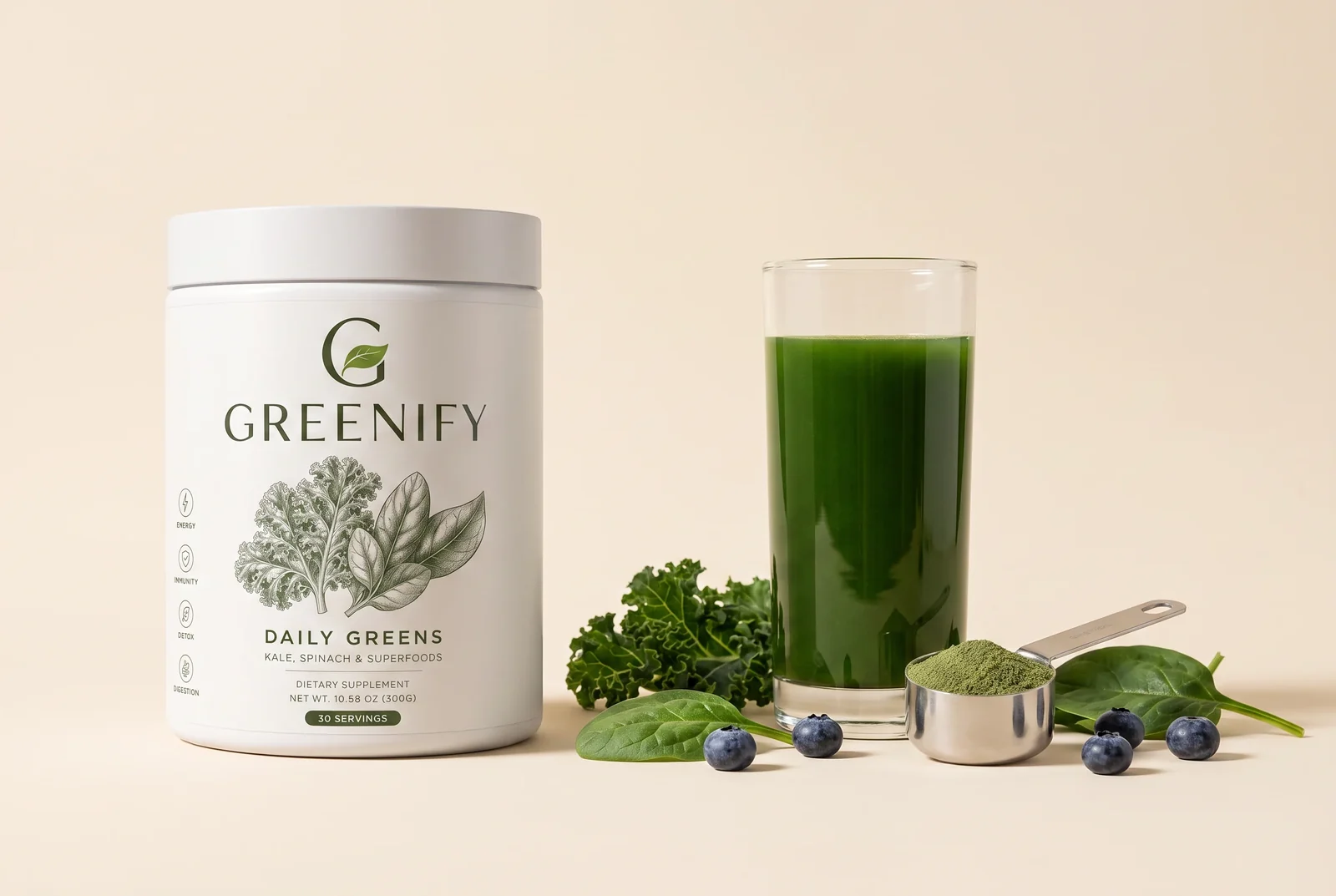
4.4g scoop, stevia leaf extract only — no artificial sweeteners
A smaller serving size and a single clean sweetener, closer to green apple and mint than to grass. Try it cold in water or blended into a smoothie, backed by a 60-day guarantee.
Does a smaller scoop size taste better than a bigger one?
Generally, yes, all else equal. A 4–6g scoop simply contains less concentrated plant matter than a 10–12g scoop, so there's proportionally less bitterness to mask with the same amount of sweetener and flavor system. This is one reason some smaller-serving formulas are described as milder — it's partly formulation and partly straightforward math.
That said, scoop size isn't the only variable. A large scoop that's mostly fiber or a flavor-forward fruit blend can taste milder than a small scoop that's heavily weighted toward wheat grass and spirulina. Read the ingredient order (ingredients are listed by descending weight) to get a sense of what you're actually tasting, not just how many grams total.
What's the best way to mix greens powder so it tastes better?
Use cold liquid, not room temperature or warm — cold suppresses bitterness perception, which is why iced tea tastes smoother than hot tea brewed the same strength. This is the single easiest fix and the one most people skip.
Don't under-dilute. Mixing a full scoop into 4oz of water concentrates the flavor unpleasantly; 8–16oz is the more forgiving range, and a full glass over ice is milder still. If it tastes too strong, add more liquid rather than more sweetener.
A shaker bottle or blender beats a spoon and glass — greens powders often contain fiber that clumps when stirred by hand, and clumps taste worse (and grittier) than a fully dissolved drink. Shaking for a full 15–20 seconds, or blending briefly, makes a real difference.
Blending into a smoothie with fruit, banana or a milk alternative is the most forgiving option if you find the standalone taste hard to get through — it dilutes the vegetal notes and adds its own sweetness and texture.
Is it fair to expect a greens powder to taste good?
It's fair to expect 'mild and drinkable within a couple of tries' — it's not fair to expect it to taste like juice or a flavored soda. Taste is also genuinely individual: some people find a formula pleasant on day one, while others need a week of trying different liquids and ratios before it clicks. Neither reaction means the product is defective.
If a formula still tastes unpleasant after trying cold water, more dilution and a shaker bottle, blending it into a smoothie with fruit is the realistic fallback — and a real money-back guarantee (check the return window before buying) is the honest safety net if taste genuinely doesn't work for you.
Frequently asked questions
- What is the mildest tasting greens powder?
- There's no universal answer since taste is subjective, but formulas with a smaller scoop size, a stevia or monk fruit sweetener, and a higher proportion of fruit powders relative to grass-based greens tend to taste milder. Reading the ingredient order on the panel is more useful than trusting a 'tastes great' claim.
- Why does my greens powder taste like grass?
- Because it likely contains wheat grass, alfalfa, spirulina or similar chlorophyll-rich ingredients, which are naturally grassy and slightly bitter. This is a sign of the plant content in the formula rather than a defect.
- Does stevia or monk fruit taste better in greens powder?
- Both are commonly used and well tolerated; the difference is subtle and often comes down to personal preference. Stevia can carry a faint licorice-like aftertaste for some people, while monk fruit is generally described as cleaner, though both work similarly well at masking bitterness.
- Should I mix greens powder with water or juice?
- Cold water is the standard base and lets you judge the formula's real taste, but juice, coconut water or a milk alternative will noticeably soften bitterness if you find plain water too strong. Whichever you choose, cold liquid works better than room temperature.
- Why does my greens powder taste worse some days than others?
- This is usually about mixing consistency, not the product changing. Insufficient shaking, less liquid than usual, or a different liquid temperature can all make the same scoop taste noticeably different from one day to the next.
- Can I hide the taste of greens powder in a smoothie?
- Yes, this is the most effective fix if the standalone taste is difficult for you. Blending with banana, berries and a milk alternative dilutes the vegetal notes considerably and is a common workaround even among people who otherwise like the plain version.