Comparisons
Bloom vs Amazing Grass (2026): The Budget Greens Face-Off
Last updated: August 2026
The two cheapest greens powders most people actually consider, roughly fourteen cents apart. Flavors and extras against organic certification and shelf availability.
Greenify Editorial • August 2, 2026 • 9 min read
Written and fact-checked by the Greenify nutrition team against product labels and published nutrition guidance. Our editorial standards
- Comparison
- Bloom
- Amazing Grass
- Budget
Bloom vs Amazing Grass is the budget end of this category, decided by cents rather than dollars. If your budget for a greens powder is a dollar a serving rather than three, this is the comparison that matters. Bloom Greens & Superfoods sits at about $1.04 a serving and is built on flavor variety, with digestive enzymes and adaptogens included. Amazing Grass Green Superfood sits at about $0.90, carries organic certification, is stocked in ordinary supermarkets and runs a simpler wheatgrass-based formula. Neither brand publishes individual ingredient doses, which turns out to be the most useful thing to know about both of them. This comparison works through price, transparency, extras, formula breadth, taste and terms with an honest winner in each, using publicly available information as of August 2026.
Why do people compare Bloom and Amazing Grass?
These two are the honest budget shortlist. Once a shopper decides that $79 a month is not happening, the field narrows quickly to a handful of powders around the dollar mark, and Bloom and Amazing Grass are the two with real distribution and name recognition. They arrive from opposite directions: Amazing Grass is the long-standing health-food-aisle staple, and Bloom is the social-first brand that made greens powders taste like a drink.
The tension is a clean one. Bloom offers flavors and extras — a rotating flavor lineup plus enzymes and adaptogens in the blend. Amazing Grass offers organic certification, a simpler wheatgrass-based formula and the lowest price of the two, with the practical advantage that you can pick it up in a supermarket instead of waiting for delivery.
What neither offers is dose transparency, and that is worth stating early because it is the question that would actually settle a formula argument. Both use proprietary blends. Any claim either brand makes about a specific botanical is unverifiable from the panel, so the sensible way to choose between them is on the things you can check: price, certification, availability and taste.
Bloom vs Amazing Grass: how do they compare on paper?
Here is what we can verify from public pricing and label copy as of August 2026. Where a brand does not publish a figure, we leave it unstated.
| Bloom Greens & Superfoods | Amazing Grass Green Superfood | |
|---|---|---|
| Cost per serving | ~$1.04 | ~$0.90 |
| Formula focus | Flavor-first greens blend with extras | Simpler wheatgrass-based greens formula |
| Dose transparency | Proprietary blends, no individual doses | Proprietary blends, no individual doses |
| Enzymes | Digestive enzyme blend included | Not the product's headline claim — check label |
| Adaptogens | Included in the blend | Not the product's headline claim — check label |
| Organic certification | Not positioned as organic | Organic certified |
| Flavors | Many, rotating — widest range in the category | Several, led by original and berry styles |
| Availability | Primarily direct and online retail | Widely stocked in physical retail |
| Guarantee | Standard brand returns policy — check current terms | Retailer-dependent; check current terms |
| Subscription | Subscribe-and-save offered | Often bought one-time at retail |
Which is cheaper per serving?
Winner: Amazing Grass, narrowly. About $0.90 against about $1.04 is roughly fourteen cents a serving, or a little over $4 a month for daily use — real, but not the kind of gap that should override a preference. Amazing Grass has held the budget benchmark position in this category for years, and nothing else with comparable distribution consistently undercuts it.
The subtler cost point favours Amazing Grass too: it is a retail product, so you can buy one tub, try it, and stop, without a subscription flow or a shipping wait. Bloom's best pricing generally assumes subscribe-and-save, which means the advertised comparison is against an ongoing commitment.
That said, if Bloom's extras replace a separate purchase for you — a digestive enzyme supplement, say — the fourteen cents is recovered instantly. Price per serving is only a fair comparison when the two servings are doing the same job, and here they are not quite.

Which one tells you what is actually in the scoop?
Winner: neither, and this is the category that should decide how much confidence you place in either label. Both brands group their greens, fruits and any extras into proprietary blends, so you can read the ingredient list and the blend total but not how much of any individual item you are drinking. Ingredient order tells you relative position, not amount.
The practical consequence is that fairy-dusting cannot be ruled out on either side. A panel can name a fashionable botanical and contain a few milligrams of it, and no amount of marketing copy substitutes for a printed weight. This is not a knock specific to budget powders — it is the norm across the category, including in brands charging three times as much.
If dose transparency is genuinely your priority, the honest answer is that neither of these is the product for you, and you should shortlist brands that print individual or per-blend weights instead. Choosing between two undisclosed formulas on the strength of their ingredient lists is guessing with extra steps.
Which formula covers more ground?
Winner: Bloom. Its blend includes digestive enzymes and adaptogens alongside the greens and fruits, which is more scope than a wheatgrass-led formula sets out to provide. If you want a budget powder that gestures at the all-in-one idea rather than sticking to greens, Bloom is the closer fit.
Amazing Grass is doing something different and doing it deliberately. A simpler organic wheatgrass-based formula has fewer ingredients competing for the same scoop, which at least means the headline greens are not sharing space with two dozen extras. For a shopper whose goal is 'more greens in my day, cheaply', that is arguably the better-designed product.
Both share the ceiling that comes with the price. Neither is going to match a $79 formula on breadth, and neither claims to. Judge them against the alternative of no greens powder at all, which is the comparison most buyers at this price point are actually making.
Which one actually tastes better?
Winner: Bloom, on the evidence available. We do not run blind panels, so treat this as a reading of what each brand has built. Bloom's rotating flavor lineup is the widest in the category, and the brand grew specifically on the claim that a greens drink can taste like something you look forward to. That is a real product achievement, not just marketing.
Amazing Grass offers several flavors, but the underlying wheatgrass character is more assertive, and its original style is best described as green — which some people prefer and others cannot get past. Mixing it into juice or a smoothie is a common workaround and worth planning for rather than discovering.
This is the category with the most practical weight at a budget price. If a $27 tub goes stale in the cupboard because you disliked it, you did not save money over the more expensive product you would have finished. Buy the one you will drink.
Which has the better guarantee and terms?
Winner: Amazing Grass, on flexibility rather than on a stated policy. Because it is widely stocked in physical retail, the effective trial is buying a single tub in a shop and returning it under that retailer's normal policy — no subscription, no shipping cycle, no cancellation. That is a different kind of low-risk purchase than a money-back guarantee, and for many shoppers a more convenient one.
Bloom sells primarily direct and online with subscribe-and-save, and its returns terms should be checked on its current policy page before you buy. Neither brand publishes a guarantee window in the class of the 90-day policies at the premium end of the category, so do not assume one.
The general rule at this price point: buy the smallest available container first. A budget powder is cheap enough that a single-tub trial costs less than most subscription minimums, and it settles the taste question definitively.
So which should you buy?
If price and organic sourcing lead your list, buy Amazing Grass — it is the cheaper product, it carries organic certification, and you can restock it without thinking about it. If you know from experience that you abandon anything that tastes green, buy Bloom, accept the extra four dollars a month, and use the flavor range to keep the habit alive.
What we would not do is dress up a fourteen-cent gap as a value verdict. At this price point the products are close enough that adherence, sourcing preference and convenience matter more than cost. Both will get greens into a glass daily, which is the outcome you are buying.
The shared caveat stands for both: neither label tells you how much of anything you are getting. If that bothers you more than the price difference — and for some buyers it should — then the choice is not between these two, and the next section is where we say plainly that we have a product in this argument too.
Publisher disclosure
Full disclosure: we make one too
This article is published by Greenify, and we make a greens powder — Daily Greens. We kept it out of the comparison above on purpose, because a review that quietly steers every category toward the publisher's own product is not a review. Everything above stands on its own: if the honest answer for you is one of the two brands compared, buy that one.
Here is our case, stated plainly so you can check it against the label. Daily Greens prints the weight of each of its four blends on the panel rather than hiding them in one proprietary total, so you can see how a 4.4g scoop is allocated instead of guessing. That scoop carries 56 ingredients, 2.5 billion CFU across four named probiotic strains, five digestive enzymes and three adaptogens — a narrower ingredient count than the kitchen-sink formulas, at weights you can read. It runs $1.40–$2.33 per day depending on the pack you choose, there is no subscription to cancel, and it is covered by a 60-day money-back guarantee. Our probiotic count is lower than several products above, and if maximum CFU is your priority you should buy on that.
| Greenify Daily Greens | |
|---|---|
| Price per day | $1.40–$2.33, no subscription required |
| Ingredients | 56, in four blends with printed weights |
| Dose transparency | Each blend weight disclosed (2.6g superfood, 1.2g herbs, 406mg fiber) |
| Probiotics | 2.5 billion CFU, four named strains |
| Enzymes | Five digestive enzymes |
| Adaptogens | Ashwagandha, Korean ginseng, eleuthero |
| Scoop size | 4.4g |
| Guarantee | 60-day money-back |
Published by Greenify
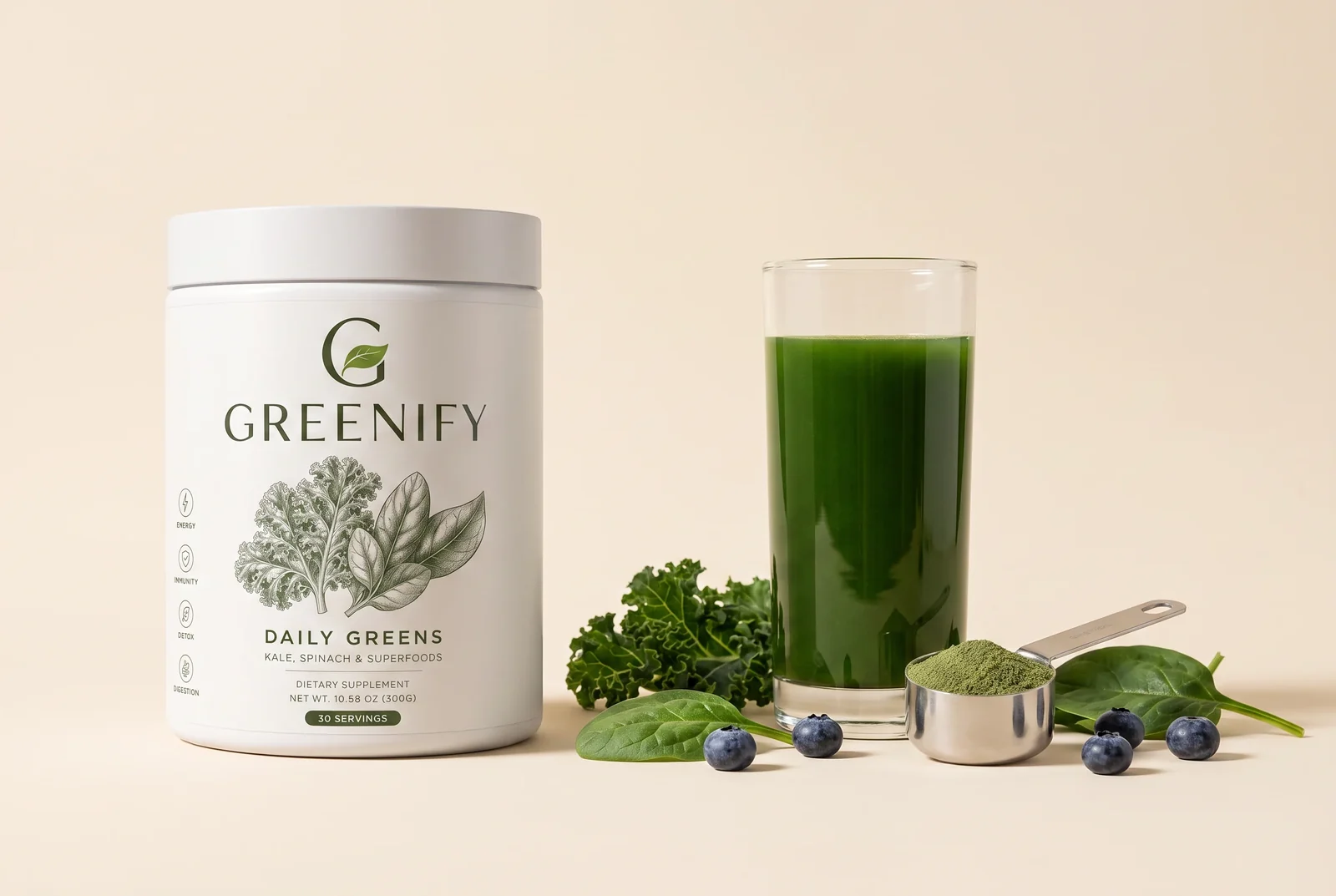
A 4.4g scoop with the blend weights printed on it
56 ingredients, 2.5B CFU across four named strains, five enzymes and three adaptogens — $1.40–$2.33 a day, no subscription, 60-day money-back guarantee.
Frequently asked questions
- Is Bloom better than Amazing Grass?
- It depends on what you weigh. As of August 2026 Bloom offers more flavors plus digestive enzymes and adaptogens at about $1.04 a serving, while Amazing Grass is cheaper at about $0.90, carries organic certification and is easier to buy in a shop. Neither discloses individual ingredient doses, so formula comparisons between them cannot be verified from the labels.
- What's the cheapest good greens powder?
- Among widely available options as of August 2026, Amazing Grass Green Superfood is consistently the least expensive at roughly $0.90 a serving, with Bloom close behind at about $1.04. Cheap only counts if you drink it, so pick the flavor you will finish.
- Do either of them list individual ingredient doses?
- No. Both rely on proprietary blends as of August 2026, which means you can read the ingredient list and the blend totals but not how much of any single ingredient is in a serving.
- Which one is organic?
- Amazing Grass. Organic certification is central to how Green Superfood is sourced and marketed; Bloom is not positioned as an organic product.