
Comparisons
Bloom vs AG1 (2026): An Honest Comparison
Last updated: August 2026
Two of the most-bought greens powders in the world, separated by roughly $1.60 a serving. A category-by-category comparison with a real answer at the end.
Greenify Editorial • August 2, 2026 • 8 min read
Written and fact-checked by the Greenify nutrition team against product labels and published nutrition guidance. Our editorial standards
- Comparison
- Bloom
- AG1
- Greens powder
Bloom vs AG1 is the most searched matchup in the greens category, and the gap is mostly price. Bloom Greens & Superfoods and AG1 are probably the two greens powders you have actually heard of, and they sit at opposite ends of the same shelf. Bloom is the one that arrived through a phone screen: mango, coconut, berry, around a dollar a serving, and a taste profile built so that a first-time greens drinker finishes the glass. AG1 is the one with the travel packs, the podcast reads and the $79 monthly subscription. People compare them because they are trying to answer a single question — is the expensive one worth roughly two and a half times the money? This comparison works through price, dose transparency, probiotics and enzymes, formula breadth, taste and guarantee terms, with an honest winner in each, using publicly available information as of August 2026.
Why do people compare Bloom and AG1?
These two products are rarely bought by the same shopper on the same day, which is exactly why the comparison keeps coming up. Bloom is a first greens powder. It is priced like a grocery item, marketed on flavor, and sold heavily on social platforms where the pitch is that it tastes like a smoothie rather than a supplement. AG1 is positioned as a considered, once-a-day foundational product, priced like a subscription service, and marketed on comprehensiveness. A shopper comparing them is usually deciding between two philosophies rather than two labels.
The honest tension is this: AG1 gives you more ingredients, a much higher probiotic count and a longer guarantee, and Bloom gives you something you will look forward to drinking at roughly a third of the cost. Neither of those is a trick. There is a real argument that a greens powder you finish every morning at $1.04 outperforms a better formula you abandon in week three because it is a recurring line item on your card.
There is also one place where the two brands are more alike than either marketing suggests. Both rely on proprietary blends for most of their formula, which means neither label lets you check how much of any single ingredient you are getting. That matters for the value question, and we come back to it below.
Bloom vs AG1: how do they compare on paper?
Here is everything we can verify from public pricing and label copy as of August 2026. Where a brand does not publish a figure, we say so rather than estimating it.
| Bloom Greens & Superfoods | AG1 | |
|---|---|---|
| Price | ~$1.04 per serving | $79/month subscription or $99 one-time, 30 servings |
| Cost per serving | ~$1.04 | ~$2.63 subscription, ~$3.30 one-time |
| Ingredient count | Not published as a single figure | 75 ingredients |
| Dose transparency | Proprietary blends, no individual doses | Mostly proprietary blends, few individual doses |
| Probiotics | Included; CFU not the headline claim | 10 billion CFU (Next Gen formula) |
| Enzymes | Digestive enzyme blend included | Enzyme blend included |
| Adaptogens | Included in the blend | Included in the blend |
| Flavors | Many, rotating — the widest range in the category | One core formula |
| Guarantee | Standard brand returns policy — check current terms | 90-day money-back guarantee |
| Subscription | Subscribe-and-save offered | Subscription is the headline price |
Which is cheaper per serving?
Winner: Bloom, decisively. At roughly $1.04 a serving, Bloom costs about $31 a month. AG1 at $79 on subscription works out to about $2.63 a serving, and $99 one-time pushes it to about $3.30. That is a difference of roughly $48 to $68 every month, or between $575 and $815 over a year — real money, and enough to fund a separate protein powder or a gym membership alongside it.
The fair counter-argument is that price per serving is only meaningful once you know what is in the serving, and AG1 does put more distinct ingredients and a much higher probiotic count into its scoop. If you were buying a separate probiotic anyway, part of the AG1 premium is absorbing a product you would otherwise pay for. That reasoning has limits when doses are undisclosed, but it is not empty.
There is a subtler cost point in Bloom's favour: it is easy to buy once. AG1's headline price assumes an ongoing subscription, and the one-time price is 25% higher. Shoppers who dislike recurring commitments are effectively quoted the $99 figure, which widens the gap further.
Which one tells you what is actually in the scoop?
Winner: neither, honestly. This is the category both brands lose. Bloom groups its greens, fruits, enzymes and adaptogens into proprietary blends, so you can see the ingredient list and the total blend weight but not how much spirulina or ashwagandha you are getting. AG1 does the same across most of its 75 ingredients. In both cases the ordering of an ingredient list tells you relative position, not amount.
Why this matters practically: a formula can list an impressive botanical and include a few milligrams of it. That is the fairy-dusting problem, and it is impossible to rule out from either label. With AG1 the stakes are higher simply because there are 75 ingredients sharing one scoop — the more names on the panel, the more arithmetic sits behind the proprietary total.
To be fair to AG1, it publishes more supporting documentation than most of the category, discloses its 10 billion CFU figure and names its probiotic approach, and it has been third-party tested for banned substances. Bloom's disclosure is thinner. So if you insist on splitting this category, AG1 edges it on documentation while both fall short on the thing that would settle it: printed individual or per-blend doses.
Which has better probiotics and enzymes?
Winner: AG1. Its 10 billion CFU count in the Next Gen formula is a headline number Bloom does not attempt to match, and probiotic content is the clearest quantitative difference between these two products. If your reason for buying a greens powder is that you want a probiotic and a greens blend in the same glass, AG1 delivers more of the first by a wide margin.
Two caveats keep this from being a rout. CFU count is a measure of quantity, not of strain suitability — a higher count of strains that do not match your goals is not automatically better than a lower count of ones that do. And CFU at manufacture is a different claim from CFU at the end of shelf life, which is why the wording on any probiotic label is worth reading closely.
On enzymes the two are much closer: both include a digestive enzyme blend, and neither publishes activity units per enzyme in a way that would let you compare them properly. Call enzymes a draw and give AG1 the probiotic point.
Which formula covers more ground?
Winner: AG1. Seventy-five ingredients is among the broadest single-scoop formulas sold at scale, spanning greens, fruit and vegetable concentrates, adaptogens, mushrooms, enzymes, probiotics and a vitamin and mineral base. If you want one scoop to be your multivitamin, greens drink and probiotic simultaneously, AG1 is built for precisely that job and Bloom is not trying to be.
Breadth has a cost that has nothing to do with money. Every ingredient added to a fixed scoop reduces the space available for the others, so a very long panel almost guarantees that some entries are present in token amounts. Without disclosed doses you cannot tell which are meaningful and which are there to lengthen the list. This is the central critique of kitchen-sink formulas, and it applies to AG1 as much as to any of its rivals.
Bloom's formula is narrower and more flavor-led, with greens, fruits, enzymes and adaptogens in a blend designed to mix into something pleasant. That is a legitimate design choice rather than a failure — it is just a different product with a different promise.
Which one actually tastes better?
Winner: Bloom, on the evidence available. Taste is subjective and we do not run a blind panel, so we will not pretend to score flavor objectively. What we can compare is the range on offer, and Bloom's rotating flavor lineup — mango, coconut, berry and its seasonal variants — is the widest in the category by a distance. That range exists because the brand grew on the promise that greens can taste like a drink you want.
AG1 sells one core formula with a characteristic pineapple-vanilla profile. Reviews of it are genuinely divided: some people find it perfectly drinkable in cold water, others find it grassy or too sweet. A single flavor is a real limitation on a product you are meant to drink 365 times a year, and there is no fallback if you dislike it.
The practical point behind the taste question is adherence. A greens powder does nothing in the cupboard. If flavor variety is what makes you consistent, that is a legitimate reason to buy the cheaper product — and it is probably the strongest argument in Bloom's favour overall.
Which has the better guarantee and subscription terms?
Winner: AG1. A 90-day money-back guarantee is the most generous return window among the major greens powders, and it is meaningfully aligned with how these products are meant to be used. Nobody can evaluate a daily supplement in a week; three months is long enough to finish a canister, restart, and decide honestly. Credit where it is due — that policy costs AG1 money and it lowers the risk of an expensive first purchase.
The subscription structure is where AG1 is less friendly. The advertised $79 is a subscription price, the one-time price is $99, and the shopper who wants to try one canister without any ongoing commitment pays the premium. Bloom offers subscribe-and-save too, and its standard returns terms are less generous than AG1's, so check its current policy before you buy.
If you hate managing subscriptions, factor in the admin, not just the money. A product you have to remember to pause has a small ongoing cost in attention that never appears on the label.
So which should you buy?
For most people asking this question, Bloom is the more sensible purchase and AG1 is the more complete product. That sounds like a dodge; it is not. If your realistic alternative to a greens powder is no greens powder, a $1.04 serving in a flavor you enjoy is the version of this habit you will still have in six months, and consistency is the only thing about any supplement that is not theoretical.
AG1 earns its price for a specific buyer: someone who wants breadth deliberately, values 10 billion CFU in the same scoop, travels enough for the single-serve packs to matter, and treats $79 a month as a settled line in the budget rather than a decision to revisit. For that buyer the 90-day guarantee makes the trial almost risk-free, and the documentation is better than most of the category.
Where we would push back on both brands is transparency. Neither publishes the individual doses that would let you check whether the ingredients you are paying for are present in amounts that matter. That is the standard question worth asking of any greens powder — including, as the next section makes clear, ours.
Publisher disclosure
Full disclosure: we make one too
This article is published by Greenify, and we make a greens powder — Daily Greens. We kept it out of the comparison above on purpose, because a review that quietly steers every category toward the publisher's own product is not a review. Everything above stands on its own: if the honest answer for you is one of the two brands compared, buy that one.
Here is our case, stated plainly so you can check it against the label. Daily Greens prints the weight of each of its four blends on the panel rather than hiding them in one proprietary total, so you can see how a 4.4g scoop is allocated instead of guessing. That scoop carries 56 ingredients, 2.5 billion CFU across four named probiotic strains, five digestive enzymes and three adaptogens — a narrower ingredient count than the kitchen-sink formulas, at weights you can read. It runs $1.40–$2.33 per day depending on the pack you choose, there is no subscription to cancel, and it is covered by a 60-day money-back guarantee. Our probiotic count is lower than several products above, and if maximum CFU is your priority you should buy on that.
| Greenify Daily Greens | |
|---|---|
| Price per day | $1.40–$2.33, no subscription required |
| Ingredients | 56, in four blends with printed weights |
| Dose transparency | Each blend weight disclosed (2.6g superfood, 1.2g herbs, 406mg fiber) |
| Probiotics | 2.5 billion CFU, four named strains |
| Enzymes | Five digestive enzymes |
| Adaptogens | Ashwagandha, Korean ginseng, eleuthero |
| Scoop size | 4.4g |
| Guarantee | 60-day money-back |
Published by Greenify
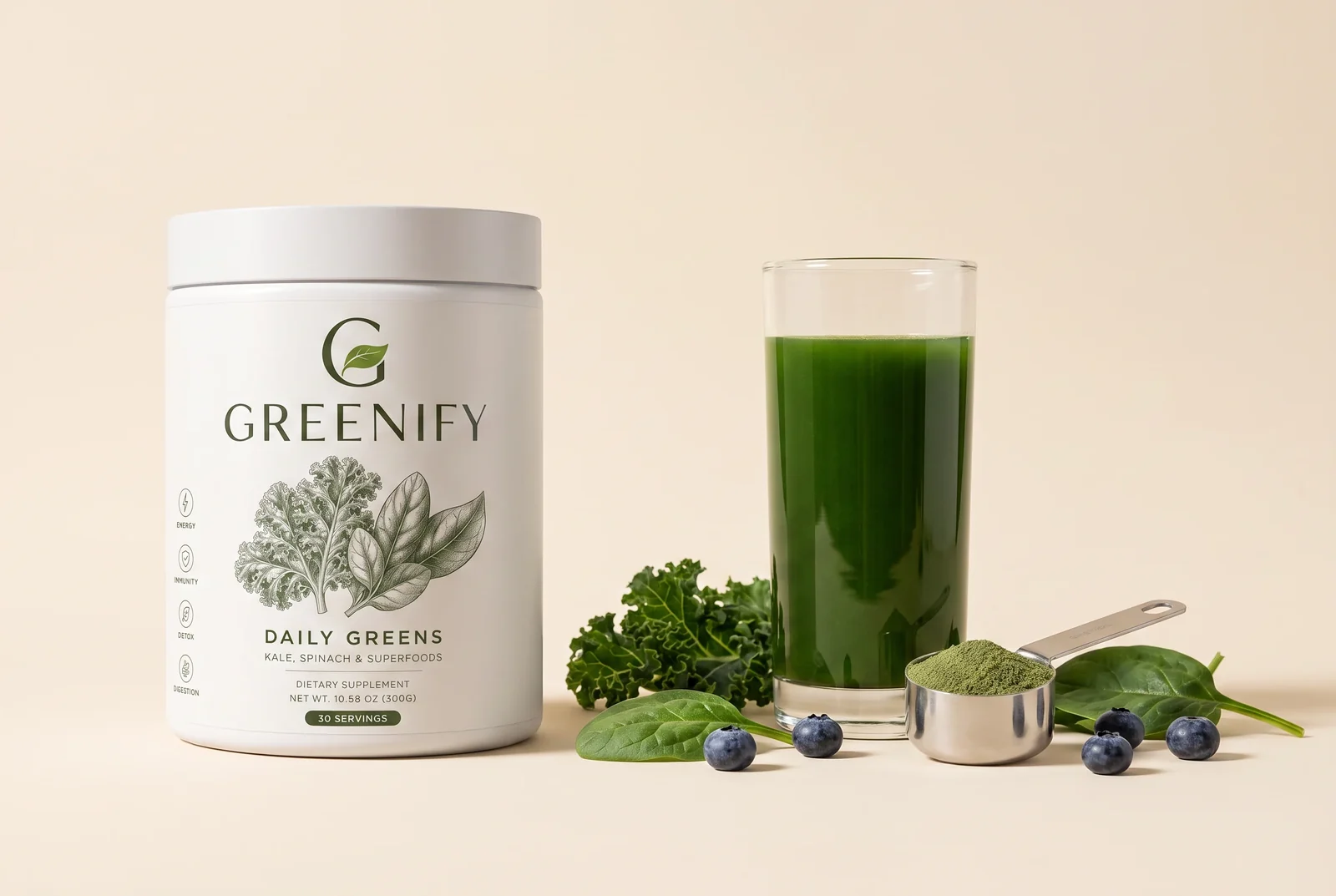
A 4.4g scoop with the blend weights printed on it
56 ingredients, 2.5B CFU across four named strains, five enzymes and three adaptogens — $1.40–$2.33 a day, no subscription, 60-day money-back guarantee.
Frequently asked questions
- Is Bloom as good as AG1?
- On formula breadth and probiotic count, no — AG1 carries 75 ingredients and 10 billion CFU as of August 2026, and Bloom does not compete on either. On value and drinkability, Bloom is the stronger buy at roughly $1.04 a serving against $2.63–$3.30 for AG1. Both rely mostly on proprietary blends, so neither lets you verify individual ingredient doses.
- Why is AG1 so expensive?
- AG1 prices at $79 a month on subscription or $99 one-time for 30 servings. The company points to 75 ingredients, a 10 billion CFU probiotic component, third-party testing for banned substances and a 90-day guarantee. Marketing scale is also part of the price of any heavily advertised supplement.
- Do Bloom and AG1 both use proprietary blends?
- Yes. As of August 2026 both group most of their ingredients into proprietary blends, so you can read the ingredient list and the blend total but not how much of any single ingredient is in a serving.
- Which one has a better money-back guarantee?
- AG1, clearly — its 90-day money-back guarantee is the longest window among the major greens powders. Check Bloom's current returns policy directly, as its terms are less generous.