
Comparisons
Greenify vs Field of Greens (2026): Printed Doses vs Organic Whole Foods
Last updated: August 2026
Greenify vs Field of Greens puts a printed-dose, four-blend formula up against a USDA-organic, whole-food-only canister with a doctor-formulated pitch. We publish one of the two, so here is the honest version, including where the other one wins.
Greenify Editorial • August 8, 2026 • 9 min read
Written and fact-checked by the Greenify nutrition team against product labels and published nutrition guidance. Our editorial standards
- Comparison
- Field of Greens
- Labels
- Daily Greens

Greenify vs Field of Greens is a comparison between two very different philosophies for the same daily habit. We sell one of the two products below, which is exactly why the only version of this comparison worth publishing is one that names the categories where we lose. Field of Greens, made by Brickhouse Nutrition, wins on USDA organic certification, on a whole-food-only ingredient list with no proprietary blends to decode, and on a longer track record as a doctor-formulated brand. Daily Greens wins on printed dose transparency by blend, on a disclosed probiotic and enzyme system, and on price per day. This article puts both products in one table and works through price, sourcing, dose disclosure, probiotics, taste and guarantee terms as of August 2026, with Greenify included directly in the comparison rather than tacked on afterwards.
Greenify vs Field of Greens: the full comparison table
Field of Greens is a USDA-certified organic whole-food fruit-and-vegetable powder made by Brickhouse Nutrition, sold in canisters of roughly 30 servings and marketed around its doctor-formulated origin story and its organic sourcing rather than around printed per-ingredient weights or a CFU count. Daily Greens is a four-blend powder that prints the weight of each blend on its panel. Both are once-daily scoops mixed into water.
Where Field of Greens does not publish a figure — such as an exact probiotic count or individual fruit-and-vegetable weights within its blend — we have written 'not published — check the current label' rather than estimate one. Treat every number below as a snapshot dated August 2026.
| Greenify Daily Greens | Field of Greens | |
|---|---|---|
| Price | $1.40–$2.33 per serving | ~$79.95 per canister one-time, lower on subscription (as of August 2026 — check current pricing) |
| Servings per container | 30 | ~30 |
| USDA Organic certified | No | Yes |
| Ingredient sourcing | Mix of whole-food powders, extracts and named strains | Whole-food fruit and vegetable powders only |
| Blend weights disclosed | Yes — 2.6g / 1.2g / 406mg / probiotic blend | Not published — check the current label |
| Probiotic CFU | 2.5 billion, 4 named strains | Not a headline claim — check the current label |
| Digestive enzymes | 5, named on the panel | Not published — check the current label |
| Adaptogens | Ashwagandha, Korean ginseng, eleuthero | Not the focus of the formula |
| Serving size | 4.4g | Not published — check the current label |
| Subscription required | No | No, but subscription lowers the price |
| Money-back guarantee | 60 days | Check current brand terms |
| Brand positioning | Printed-dose, four-blend transparency | Doctor-formulated, organic whole-food story |
Where Field of Greens wins
USDA organic certification is the clearest one, and it is not a marketing gesture — it is a verifiable, third-party-audited standard covering how the produce was grown and processed. Daily Greens is not marketed as organic, and if organic certification is a hard requirement for you, that alone settles the decision in Field of Greens' favour.
The second is ingredient philosophy. Field of Greens is built entirely from whole fruit-and-vegetable powders rather than a mix of extracts, isolated compounds and named strains. For a buyer who wants to be sure everything in the canister traces back to a recognisable food, that is a genuinely simpler proposition than reading an extract-heavy panel and looking up what each one is.
The third is brand track record. Field of Greens has built its reputation on a doctor-formulated story and has been on the market long enough to accumulate a substantial customer base and public reviews, which matters to buyers who weight longevity and word of mouth heavily when choosing a supplement brand.
Add to that: a whole-food-only formula sidesteps the entire debate about proprietary blends and dose disclosure, because there is no blend to itemise in the first place — the product's argument is that the ingredient list itself is the disclosure.
Where Greenify wins
Dose transparency is the reason this company exists. Our panel prints the weight of each of the four blends — 2.6g of superfoods, antioxidants and mushrooms; 1.2g of herbs and extracts; 406mg of prebiotic fiber with five named enzymes; and a four-strain probiotic blend at 2.5 billion CFU — alongside declared vitamin and mineral percentages. Field of Greens does not publish an equivalent breakdown, so you can see that it is whole-food-only but not how much of any single vegetable or fruit is in the scoop.
Probiotics and enzymes are the second. Field of Greens does not headline a CFU figure or a named enzyme system, which is consistent with its whole-food-only positioning but means anyone shopping specifically for a stated probiotic count or digestive enzyme support will not find one on that label as of August 2026.
Price is the third. At $1.40–$2.33 per serving against roughly $79.95 for a 30-serving canister one-time (about $2.66/serving before any subscription discount), Daily Greens is generally the cheaper habit at list price, though Field of Greens' subscription rate narrows that gap — check current pricing on both before comparing.
The last is how you buy. Our best per-day price comes from a one-time multi-pack rather than a recurring plan. If you would rather not manage auto-ship to get the lower price, that is a real, practical difference between the two brands.

Is Field of Greens or Greenify better for gut health?
Winner: Daily Greens, on disclosure, but with an important caveat. Daily Greens states a 2.5 billion CFU probiotic blend across four named strains plus five digestive enzymes, so you know exactly what you are getting on that front. Field of Greens does not lead with a probiotic claim, and as of August 2026 we could not find a published CFU figure on its current label — if gut-focused ingredients are your priority, check the label directly rather than assuming either way.
It is worth saying plainly that a whole-food powder can support digestion through fiber content alone, without a formulated probiotic blend, and Field of Greens' pitch has never centred on probiotics — it centres on organic whole foods. That is a legitimate, different approach, not a missing feature by accident.
If a stated probiotic strain count and named enzymes are non-negotiable for you, Daily Greens gives you that in writing. If you would rather avoid added extracts and strains altogether and trust whole-food fiber to do the work, Field of Greens' approach may suit you better.
Which is the better value per day?
Winner: it depends on which Field of Greens price you compare against. At the one-time canister price of roughly $79.95 for about 30 servings, that works out to around $2.66 a day, which sits above Daily Greens' $1.40–$2.33 range. On subscription, Field of Greens' price drops — brand subscription discounts vary and change, so check the current subscription rate before assuming the exact gap.
Daily Greens reaches its lowest per-day price through a one-time multi-pack rather than a subscription, which is the opposite structure to Field of Greens' subscription-discount model. If you dislike recurring charges, Daily Greens' multi-pack route gets you the lower price without one; if you are comfortable with a subscription, Field of Greens' discounted rate narrows the price gap considerably.
Either way, divide the total canister or tub price by the actual servings inside before comparing across brands — a 30-serving Field of Greens canister and a 30-serving Daily Greens tub are the correct like-for-like comparison, not the sticker price on the front of the box.
Which formula fits your priorities better?
If organic certification, a whole-food-only ingredient list and a doctor-formulated brand story are what you are shopping for, Field of Greens is built specifically around those three things and does them well. That is a legitimate set of priorities and this comparison should not talk anyone out of them.
If you want to see the exact weight of every blend on the panel, a stated probiotic and enzyme system, and the option to buy outright at the lowest price without a subscription, Daily Greens is built around that instead.
Neither formula is wrong, and neither is trying to be the other. The honest way to choose is to decide which of those two priorities — organic whole-food purity, or printed dose transparency — matters more to your own routine, then buy accordingly rather than treating one brand's marketing language as automatically superior to the other's.
So which should you buy?
Buy Field of Greens if USDA organic certification and a whole-food-only ingredient list are the deciding factors for you, and you are comfortable with a formula that does not itemise blend weights or lead with a probiotic count. Its doctor-formulated positioning and established track record are real, verifiable parts of its appeal.
Buy Daily Greens if you want a printed panel you can actually reason about — four blends, stated weights, a named probiotic and enzyme system — at a lower everyday price and without a subscription requirement.
Whichever you choose, read the current supplement facts panel before the marketing copy, divide the total price by the actual number of servings, and give either product a consistent run of at least eight weeks before judging whether it earns a place in your routine.
Publisher disclosure
Full disclosure: we make one too
This article is published by Greenify, and we make a greens powder — Daily Greens. We kept it out of the comparison above on purpose, because a review that quietly steers every category toward the publisher's own product is not a review. Everything above stands on its own: if the honest answer for you is Field of Greens or AG1, buy that one.
Here is our case, stated plainly so you can check it against the label. Daily Greens prints the weight of each of its four blends on the panel rather than hiding them in one proprietary total, so you can see how a 4.4g scoop is allocated instead of guessing. That scoop carries 56 ingredients, 2.5 billion CFU across four named probiotic strains, five digestive enzymes and three adaptogens. It runs $1.40–$2.33 per day depending on the pack you choose, there is no subscription to cancel, and it is covered by a 60-day money-back guarantee. We are not USDA-organic certified across the board the way Field of Greens is, and our probiotic count is lower than AG1's — if either of those is your priority, buy on that.
| Greenify Daily Greens | |
|---|---|
| Price per day | $1.40–$2.33, no subscription required |
| Ingredients | 56, in four blends with printed weights |
| Dose transparency | Each blend weight disclosed (2.6g superfood, 1.2g herbs, 406mg fiber) |
| Probiotics | 2.5 billion CFU, four named strains |
| Enzymes | Five digestive enzymes |
| Adaptogens | Ashwagandha, Korean ginseng, eleuthero |
| Scoop size | 4.4g |
| Guarantee | 60-day money-back |
Published by Greenify
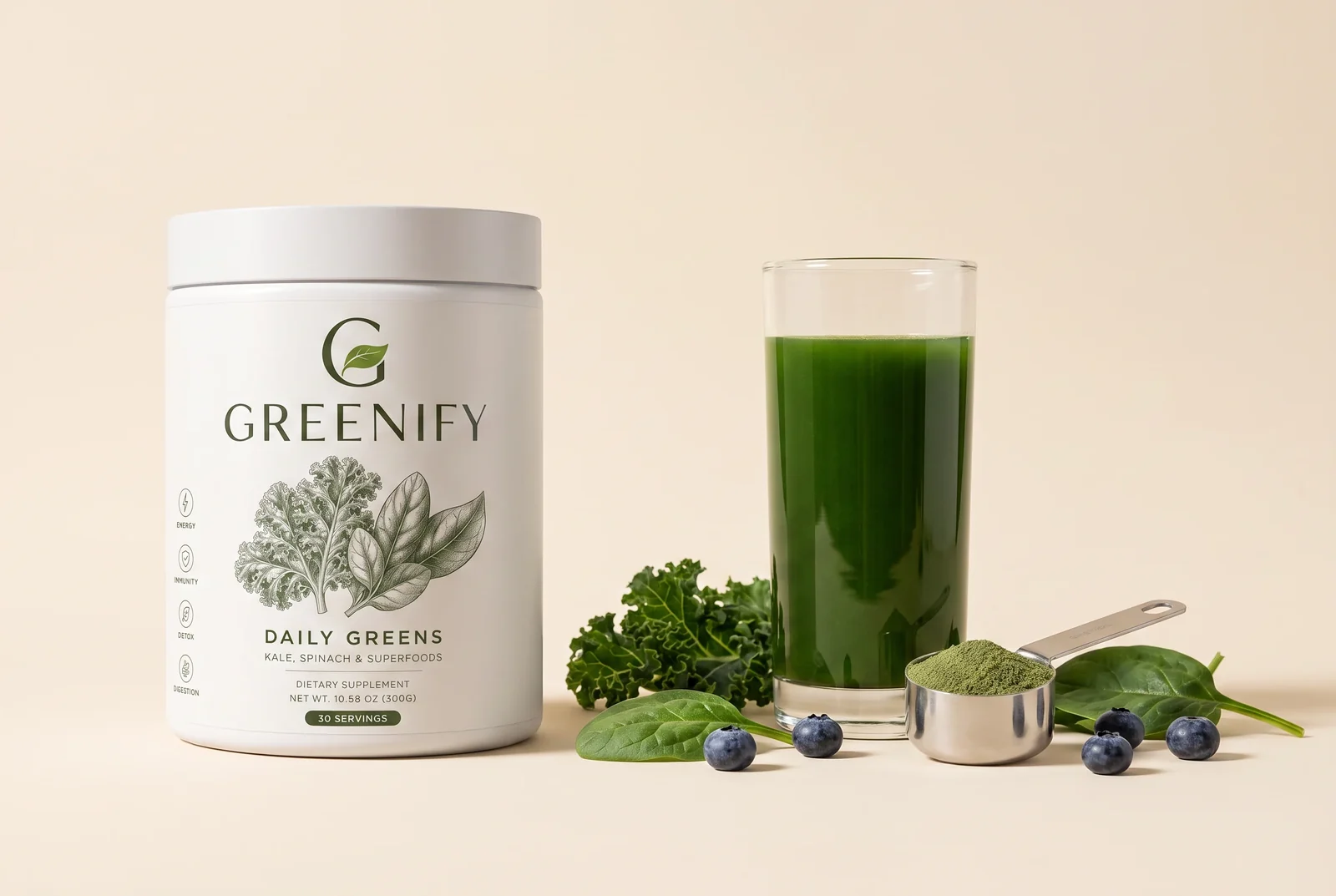
A 4.4g scoop with the blend weights printed on it
56 ingredients, 2.5B CFU across four named strains, five enzymes and three adaptogens — $1.40–$2.33 a day, no subscription, 60-day money-back guarantee.
Frequently asked questions
- Is Field of Greens organic and is Greenify Daily Greens organic?
- Field of Greens is USDA Organic certified, as of August 2026 — check the current label to confirm the certification is still in place. Daily Greens is not marketed as organic. If organic certification is a requirement for you, that alone should decide the comparison.
- Does Field of Greens contain probiotics?
- Field of Greens does not headline a probiotic CFU count on its published marketing, and we could not find a stated figure as of August 2026 — check the current label directly. Daily Greens states 2.5 billion CFU across four named strains plus five digestive enzymes.
- Which is cheaper, Field of Greens or Daily Greens?
- At list price, Field of Greens runs around $79.95 for roughly 30 servings one-time (about $2.66 a serving), lower on subscription — check current pricing. Daily Greens runs $1.40–$2.33 a serving depending on the pack, without a subscription requirement.
- Does Daily Greens print its ingredient doses the way Field of Greens does?
- Daily Greens prints the weight of each of its four blends on the panel. Field of Greens' marketing centres on being whole-food-only rather than on itemised per-ingredient weights, so it does not publish an equivalent blend-by-blend breakdown as of August 2026 — check the current label.
- Who makes Field of Greens?
- Field of Greens is made by Brickhouse Nutrition and is marketed on USDA organic sourcing, a whole-food-only ingredient list and a doctor-formulated origin story, rather than on a printed per-ingredient dose panel.