Nutrition
When Should You Drink Greens Powder? Morning vs Night
Last updated: August 2026
The best time to drink greens powder is whichever time you'll actually repeat every day. Morning suits most people, but the details around food, coffee and water temperature matter more than the clock.
Greenify Editorial • August 8, 2026 • 8 min read
Written and fact-checked by the Greenify nutrition team against product labels and published nutrition guidance. Our editorial standards
- Timing
- Routine
- Greens Powder
- Daily Greens
The best time to drink greens powder is the time you will actually take it every single day — consistency matters far more than the specific hour. That said, morning suits most people best, and if a formula contains Korean ginseng or other adaptogens intended to support daytime energy, morning is the more logical fit. An empty stomach is fine for many people, though food can help if it feels harsh on your digestion, and you should never mix it with very hot water, since heat can damage probiotics and enzymes.
When is the best time to take greens powder?
There's no single correct hour — the best time is whichever slot in your day you'll actually stick to, every day, without fail. A greens powder taken inconsistently at 'whenever you remember' does far less for you than one taken reliably at a fixed time, even if that time isn't textbook-perfect.
With that said, morning is the most common and generally sensible default. It's the easiest time to build into an existing routine (alongside breakfast or coffee), and if the formula includes adaptogens like Korean ginseng or eleuthero — traditionally associated with daytime energy and focus — taking them earlier in the day lines up with how they're meant to be used.
If mornings are chaotic for you, a consistent early-afternoon habit beats a sporadic morning one. The goal is repeatability, not perfection.
Should you take it on an empty stomach?
For many people, yes — an empty stomach, usually first thing in the morning, works fine and is a simple way to make sure you don't forget. Some people specifically prefer this because it's one less thing competing for attention with a meal.
If a scoop on an empty stomach feels harsh — some notice a bit more stomach sensitivity when concentrated plant fiber and greens hit an empty gut — there's nothing wrong with taking it with or shortly after food instead. Food can buffer that sensation for people who are prone to it, particularly during the first week or two of adjustment.
Neither approach is objectively correct. It's a matter of what your digestion tolerates and what fits your morning.
No caffeine, no crash, any time of day
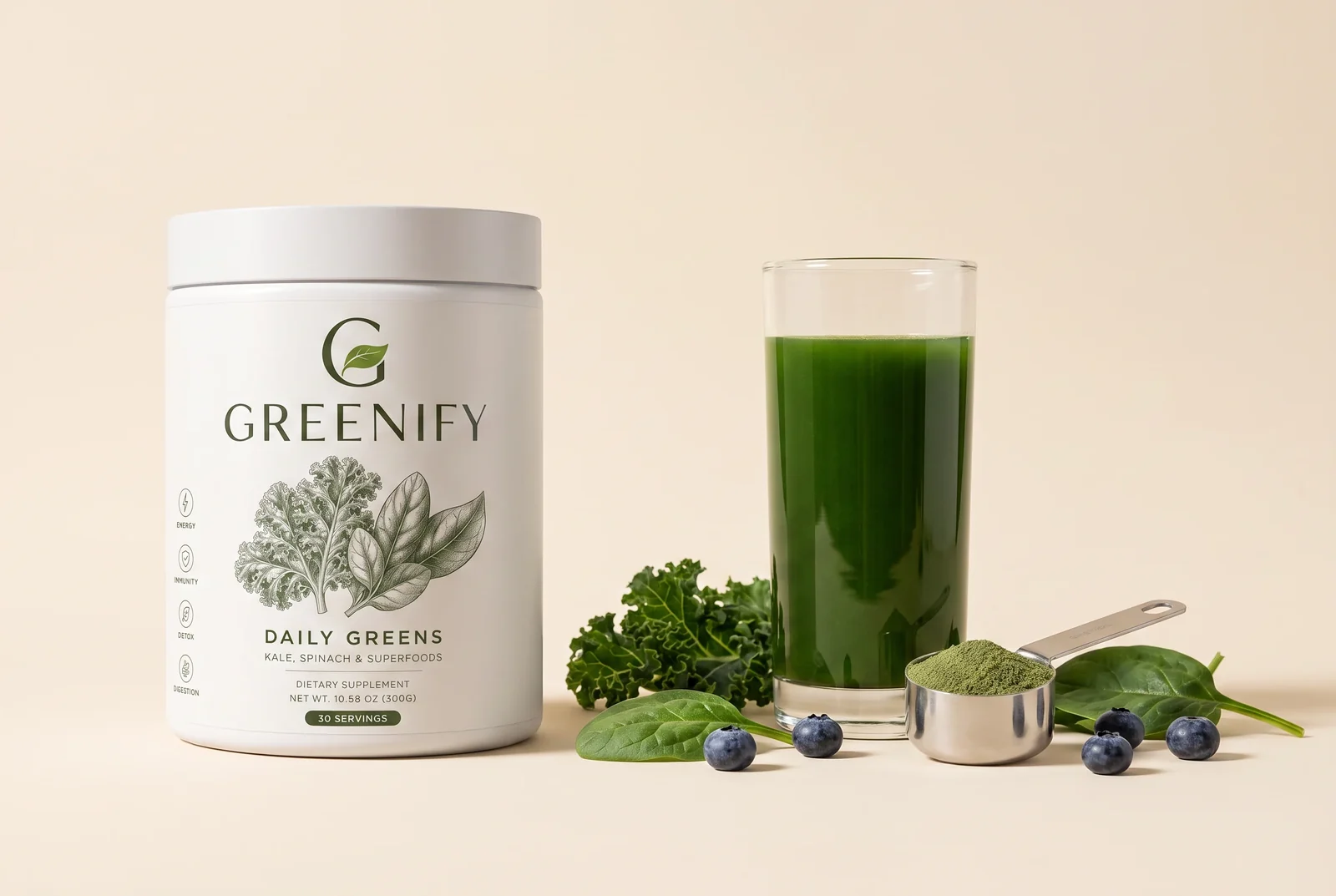
Stevia-sweetened, caffeine-free, built for a daily routine
Daily Greens is caffeine-free with three adaptogens including Korean ginseng, so it fits a morning routine without keeping you up if you prefer taking it later — $1.40-$2.33 a day, backed by a 60-day money-back guarantee.
Can you drink greens powder at night?
Yes, as long as the formula is caffeine-free. A genuinely caffeine-free greens powder has no stimulant mechanism to interfere with sleep, so an evening habit is perfectly workable for people whose routine suits that better — for example, someone who prefers preparing things the night before, or who simply has more consistent time in the evening.
The one thing to check is any whole-food ingredient that carries trace natural caffeine, like green tea leaf — it's a small amount, far below a cup of brewed tea, but a genuinely caffeine-sensitive person taking it right before bed may still want to test how they respond.
If a formula does contain added caffeine or is explicitly framed as a daytime energy product, night is the wrong slot for it regardless of how convenient it is.
Does it matter if you take it with coffee?
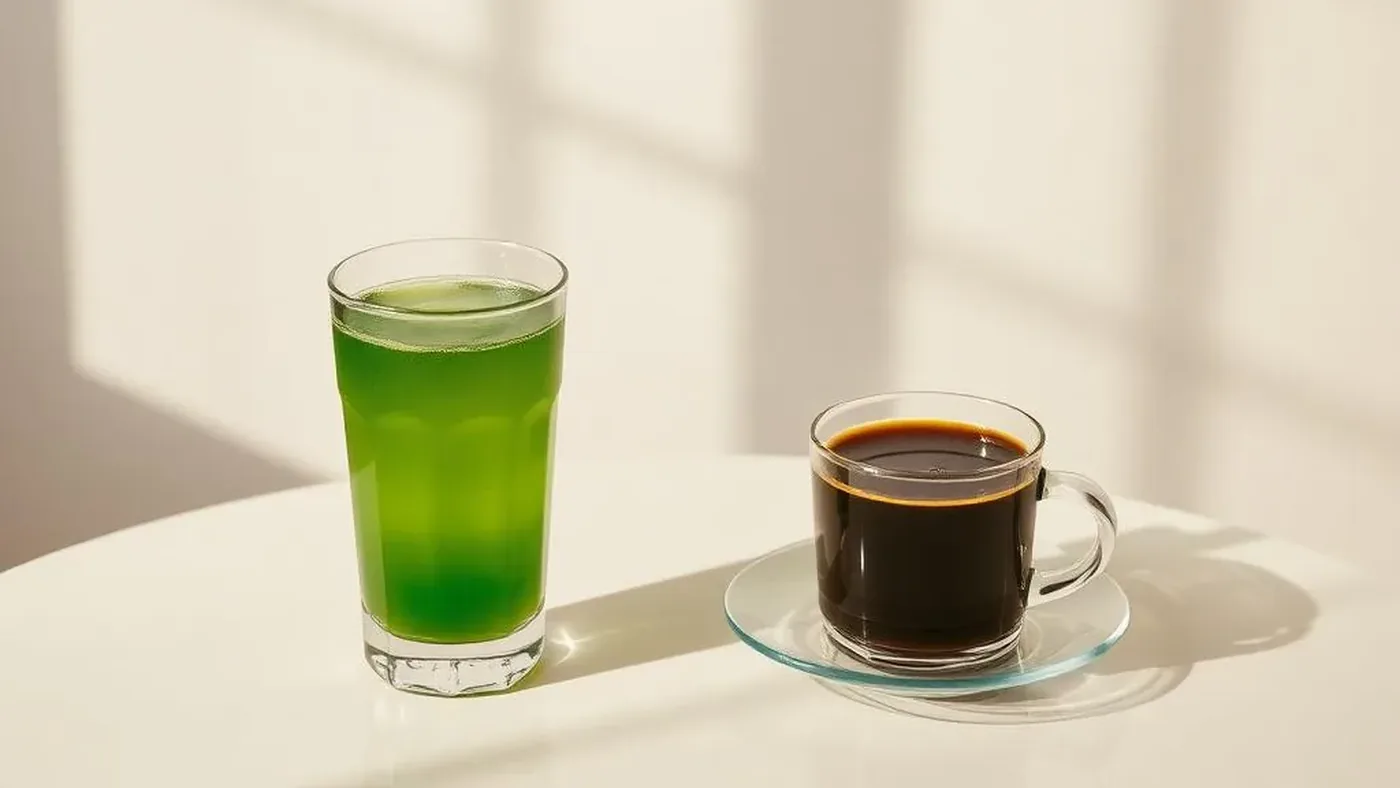
It's not harmful to drink greens powder around the same time as coffee, but if you care about mineral absorption, it's worth knowing that coffee's compounds (like tannins) can reduce absorption of certain minerals such as iron. If your greens powder contains iron and it matters to you, separating it from coffee by an hour or two is a reasonable, low-effort precaution.
The same logic applies to high-dose calcium or iron supplements taken separately from your greens powder — these can compete for absorption when taken at the exact same time. This is a minor optimization, not a safety issue, so don't let it stop you from building a habit that otherwise fits your day.
If you don't take separate mineral supplements and aren't especially sensitive to this, taking your greens powder and coffee back-to-back in the morning is a perfectly reasonable, simple routine.
What should you mix it with?
Cold or room-temperature water is the standard choice, and it's the one that best protects the ingredients. Avoid very hot water specifically — heat can degrade probiotics and digestive enzymes, two of the components doing real work in the formula, so a hot mix undermines part of what you're taking it for.
Mixing into a cold smoothie, plant milk, or juice is also fine and can make the taste more approachable, as long as the liquid isn't heated afterward (for example, don't add it to a warmed drink).
A shaker bottle gives a smoother, less clumpy result than stirring by hand with a spoon, particularly for formulas that include fiber.
Can you take it twice a day?
Most greens powders are formulated and labeled for a single daily serving, and the safe, sensible approach is to follow that labeled serving size rather than doubling up in hopes of doubling the benefit. More servings doesn't mean proportionally more effect, and it can mean more fiber and plant compounds than your gut is used to handling at once.
If you feel you need more support than one scoop provides, that's a conversation for adjusting your overall diet or speaking with a healthcare provider, not a reason to exceed the labeled amount.
How to build the habit so you actually keep it
Anchor it to something you already do every day without fail — brushing your teeth, making coffee, packing a bag — so it rides along on an existing habit rather than needing its own reminder.
Keep the container somewhere visible, not tucked in a cupboard. Visibility is one of the simplest, most reliable ways to remember a daily supplement.
Prepare for the taste and texture in advance rather than being surprised by it each time — cold water, a shaker bottle, and the right ratio make it far easier to keep going than gritting your teeth through it daily.
Judge the habit over weeks, not days. Since digestion changes commonly show within one to two weeks and energy changes over two to four, sticking with a fixed time long enough to notice is what makes the timing decision worthwhile in the first place.
Should you take greens powder with food or on an empty stomach?
Either works, and the honest answer is that the difference matters less than most timing advice implies. On an empty stomach there is nothing competing for absorption, which is why the morning slot is the popular default. With food, the meal slows gastric emptying slightly, which is often gentler if the fibre load bothers you.
If you get any bloating or queasiness taking it first thing, take it with or just after a meal instead. That single change resolves most of the early-adjustment complaints people report, and it costs you nothing in terms of the nutrients you actually absorb.
One genuine interaction is worth knowing: the calcium in a dairy-heavy meal can blunt iron absorption, and strong tea or coffee taken at the same time does the same. If iron intake is a concern for you, leave an hour between your greens serving and those drinks rather than rearranging your whole day.
Does it matter what you mix it with?
Cold water is the standard for a reason: it keeps the taste cleaner and dissolves the powder more completely than warm water, which tends to clump and concentrate the grassier notes. A shaker bottle or a small whisk does more for the experience than any flavour trick.
Mixing into a smoothie, juice or plant milk is fine, and for many people it is the difference between a habit that lasts and a canister that stops getting used. The trade-off is that a fruit-heavy smoothie adds sugar, so it is worth being deliberate rather than treating it as free.
Avoid boiling water and avoid making it the night before. Heat is unkind to some of the heat-sensitive vitamins and the live probiotic content, and a serving left sitting for hours separates and tastes noticeably worse — which is the fastest way to quietly abandon the routine.
Whatever you choose, keep it consistent. The point of a timing decision is repeatability, and a preparation you look forward to is the one you will still be doing in week ten.
Frequently asked questions
- Is it better to take greens powder in the morning or at night?
- Morning suits most people, especially if the formula contains ginseng or other adaptogens meant for daytime energy. Night is fine as long as the product is caffeine-free — the most important thing is picking a time you'll repeat daily.
- Should greens powder be taken before or after eating?
- Either works. An empty stomach is fine for many people, but taking it with or after food can help if a scoop on its own feels harsh on digestion.
- Can I mix greens powder with hot water or tea?
- It's best to avoid very hot water, since heat can damage the probiotics and digestive enzymes in the formula. Cold or room-temperature water preserves those ingredients better.
- Does drinking greens powder with coffee cancel it out?
- No, it doesn't cancel it out, but coffee can modestly reduce absorption of some minerals like iron. If that matters to you, spacing them by an hour or two is a simple precaution.
- Can you take greens powder twice a day for faster results?
- It's best to stick to the labeled serving size rather than doubling up — more servings won't necessarily speed up results and may introduce more fiber than your gut is used to at once.