
Comparisons
AG1 vs Live it Up Super Greens (2026)
Last updated: August 2026
Live it Up is the alternative most often named when people balk at AG1's price. A category-by-category comparison of a lean clean formula against the category's broadest one.
Greenify Editorial • August 2, 2026 • 9 min read
Written and fact-checked by the Greenify nutrition team against product labels and published nutrition guidance. Our editorial standards
- Comparison
- AG1
- Live it Up
- Greens powder

AG1 vs Live it Up is the switch shoppers ask about most when the subscription bill lands. Live it Up Super Greens has become the default answer to the question 'what should I buy instead of AG1?', and it earns that position on arithmetic: roughly $49.99 one-time for 30 servings, or about $1.33 a serving on subscription, against AG1's $79 a month or $99 one-time. It also takes a different formulation stance — a short, legible ingredient list with no artificial sweeteners, rather than a long panel. AG1's answer is breadth: 75 ingredients, 10 billion CFU and a 90-day guarantee. This comparison works through price, dose transparency, probiotics and enzymes, formula breadth, taste and terms with an honest winner in each, using publicly available information as of August 2026.
Why do people compare AG1 and Live it Up?
Almost every 'AG1 alternative' list published in the last two years names Live it Up, and the reason is structural rather than promotional. AG1 established what an all-in-one greens drink looks like and priced it at $79 a month; a second wave of brands then asked whether the same daily habit could exist at a third of the cost. Live it Up is the most visible of those answers.
The two brands also argue for opposite things. AG1's pitch is coverage — one scoop that spans greens, fruit and vegetable concentrates, adaptogens, mushrooms, enzymes, probiotics and a vitamin and mineral base. Live it Up's pitch is legibility — a formula short enough to read in one pass, without artificial sweeteners, at a price that does not require justification.
The honest tension is that both arguments are valid and they cannot be combined. A long panel inside a fixed scoop means smaller amounts of each ingredient; a short panel means fewer bases covered. Which failure mode you prefer is the real decision here, and price makes it lopsided for most shoppers.
AG1 vs Live it Up: how do they compare on paper?
Here is what we can verify from public pricing and label copy as of August 2026. Where a figure is not published, we say so rather than filling the cell.
| AG1 | Live it Up Super Greens | |
|---|---|---|
| Price | $79/month subscription, $99 one-time | ~$49.99 one-time for 30 servings |
| Cost per serving | ~$2.63 subscription, ~$3.30 one-time | ~$1.67 one-time, ~$1.33 subscription |
| Servings per container | 30 | 30 |
| Ingredient count | 75 ingredients | Deliberately lean — short ingredient list |
| Dose transparency | Mostly proprietary blends | Simple, transparent formula |
| Probiotics | 10 billion CFU (Next Gen formula) | Check current label |
| Sweeteners | Sweetened core formula, one flavor | No artificial sweeteners |
| Positioning | All-in-one foundational supplement | Widely ranked a top AG1 alternative |
| Guarantee | 90-day money-back | Check current brand terms |
| Subscription | Subscription is the headline price | Subscribe-and-save lowers cost to ~$1.33/serving |
Which is cheaper per serving?
Winner: Live it Up, and it is the most decisive category in this comparison. About $1.33 a serving on subscription against AG1's $2.63 means roughly $40 a month or about $470 a year in difference, and against AG1's $99 one-time price the gap widens to nearly $60 a month. There is no reading of these numbers in which AG1 is the value option.
The fair counterweight is what the extra money buys. AG1's scoop includes a 10 billion CFU probiotic component and a vitamin and mineral base; if you would otherwise buy a probiotic and a multivitamin separately, part of the premium absorbs products you were already paying for. Run that arithmetic honestly — for some shoppers it closes much of the gap, and for others who take neither it closes none of it.
There is a second, quieter cost difference. AG1's advertised price assumes an ongoing subscription and its one-time price is 25% higher, whereas Live it Up's roughly $49.99 is a straightforward single purchase. Buyers who dislike recurring commitments are quoted the worse AG1 number by default.

Which one tells you what is actually in the scoop?
Winner: Live it Up. Its whole formulation stance is a short, transparent formula, which means the panel is readable without a decoder — and a shorter list makes the arithmetic behind a fixed scoop far easier to reason about. AG1 places most of its 75 ingredients inside proprietary blends, so you can read the names and totals but not how much spirulina, ashwagandha or any single item you receive.
This is where the fairy-dusting question lands hardest on AG1. Seventy-five ingredients sharing one scoop guarantees that some are present in token amounts, and without printed doses there is no way to tell which. That is not an accusation of bad faith; it is a limitation of proprietary blends on any label, ours included where we use them.
To be fair to AG1, it publishes more supporting documentation than most of the category, states its CFU figure plainly and carries third-party testing for banned substances. Live it Up wins on the specific thing this category measures — you can see what you are drinking — while AG1 wins on documentation volume.
Which has better probiotics and enzymes?
Winner: AG1. A stated 10 billion CFU in its Next Gen formula is a quantified claim Live it Up does not put forward as a headline, and if a probiotic in the same glass as your greens is a reason you are shopping at all, AG1 is the product designed around that. Before assuming Live it Up carries live cultures or a digestive enzyme blend, check its current panel — we are not going to state either way on figures the brand does not publish prominently.
Two caveats apply to the AG1 win. CFU is a measure of quantity rather than of strain suitability, so a bigger number is not automatically a better match for your goals. And a CFU figure at manufacture is a different claim from viability at the end of shelf life, which is worth reading closely on any probiotic label.
The practical upshot: if probiotics matter to you and you choose Live it Up on price, budget for a separate probiotic. Doing so still lands well under AG1's monthly cost in most cases, which is part of why the value argument survives this category loss.
Which formula covers more ground?
Winner: AG1, comfortably. Seventy-five ingredients spanning greens, fruit and vegetable concentrates, adaptogens, mushrooms, enzymes, probiotics and a vitamin and mineral base is among the broadest single-scoop formulas sold at scale. If the outcome you want is one drink standing in for a multivitamin, a greens blend and a probiotic simultaneously, no lean formula replaces it.
Live it Up is not trying to win this category, and reading its shorter list as a deficiency misses the design. A leaner formula means fewer ingredients competing for the same scoop weight, fewer potential irritants to isolate if something disagrees with you, and a label you can actually evaluate. Plenty of people want exactly that, particularly as a first greens powder.
The sensible way to use this category is as a filter rather than a score. Write down what you want the scoop to cover. If the list is long, AG1 is built for it. If the list is 'more greens, fewer unknowns', breadth is not a benefit you are buying.
Which one actually tastes better?
Winner: too close to call honestly, with a caveat that favours Live it Up. We do not run blind panels and will not score flavor as if we had. What is verifiable is that Live it Up uses no artificial sweeteners, which is a meaningful difference for anyone who finds sucralose-style aftertastes unpleasant or has abandoned a supplement over them.
AG1 sells one core sweetened pineapple-vanilla formula, and reviews of it are genuinely divided — many people drink it happily in cold water for years, others find it grassy or oversweet. The structural weakness is the lack of an alternative: with a single flavor there is no fallback if it does not suit you.
Adherence is the reason this category matters at all. A greens powder does nothing from the back of a cupboard, and at either price point the money is wasted if you stop. If sweetener style is something you have reacted to before, treat it as a primary criterion rather than a footnote.
Which has the better guarantee and subscription terms?
Winner: AG1. Its 90-day money-back guarantee is the longest published window among the major greens powders and it is well matched to how a daily supplement has to be judged — three months is enough to finish a container, restart and decide honestly. That policy costs the company money and it genuinely lowers the risk of a first purchase at $99.
On subscription structure the advantage flips. AG1's headline $79 is a subscription rate with a 25% penalty for buying once, whereas Live it Up's roughly $49.99 is a normal one-time price with subscribe-and-save available to bring it down to about $1.33 a serving. For Live it Up's return window, check the brand's current terms rather than assuming they match AG1's.
If you are the sort of buyer who forgets to pause an auto-ship, price both products at their one-time rates and re-run the comparison — about $49.99 against $99. That is the number you will actually pay.
So which should you buy?
For most people asking this question, Live it Up is the better purchase and AG1 is the more complete product. Live it Up wins value outright, wins transparency, and avoids artificial sweeteners; AG1 wins breadth, probiotic count and guarantee length. Those are real wins on both sides, and pretending otherwise would make this article useless.
AG1 is worth its premium for a specific buyer: someone who wants coverage deliberately, values 10 billion CFU and a vitamin base in the same scoop, and treats $79 a month as settled rather than as a monthly decision. For that person the 90-day guarantee makes trying it nearly risk-free.
Everyone else should probably start with the cheaper, readable formula, add a probiotic if they want one, and see whether the habit survives eight weeks before spending three times as much on it. Where we would push back on AG1 is the same place we push back on any long panel, including our own blends: ingredient counts are marketing, printed weights are information.
Publisher disclosure
Full disclosure: we make one too
This article is published by Greenify, and we make a greens powder — Daily Greens. We kept it out of the comparison above on purpose, because a review that quietly steers every category toward the publisher's own product is not a review. Everything above stands on its own: if the honest answer for you is one of the two brands compared, buy that one.
Here is our case, stated plainly so you can check it against the label. Daily Greens prints the weight of each of its four blends on the panel rather than hiding them in one proprietary total, so you can see how a 4.4g scoop is allocated instead of guessing. That scoop carries 56 ingredients, 2.5 billion CFU across four named probiotic strains, five digestive enzymes and three adaptogens — a narrower ingredient count than the kitchen-sink formulas, at weights you can read. It runs $1.40–$2.33 per day depending on the pack you choose, there is no subscription to cancel, and it is covered by a 60-day money-back guarantee. Our probiotic count is lower than several products above, and if maximum CFU is your priority you should buy on that.
| Greenify Daily Greens | |
|---|---|
| Price per day | $1.40–$2.33, no subscription required |
| Ingredients | 56, in four blends with printed weights |
| Dose transparency | Each blend weight disclosed (2.6g superfood, 1.2g herbs, 406mg fiber) |
| Probiotics | 2.5 billion CFU, four named strains |
| Enzymes | Five digestive enzymes |
| Adaptogens | Ashwagandha, Korean ginseng, eleuthero |
| Scoop size | 4.4g |
| Guarantee | 60-day money-back |
Published by Greenify
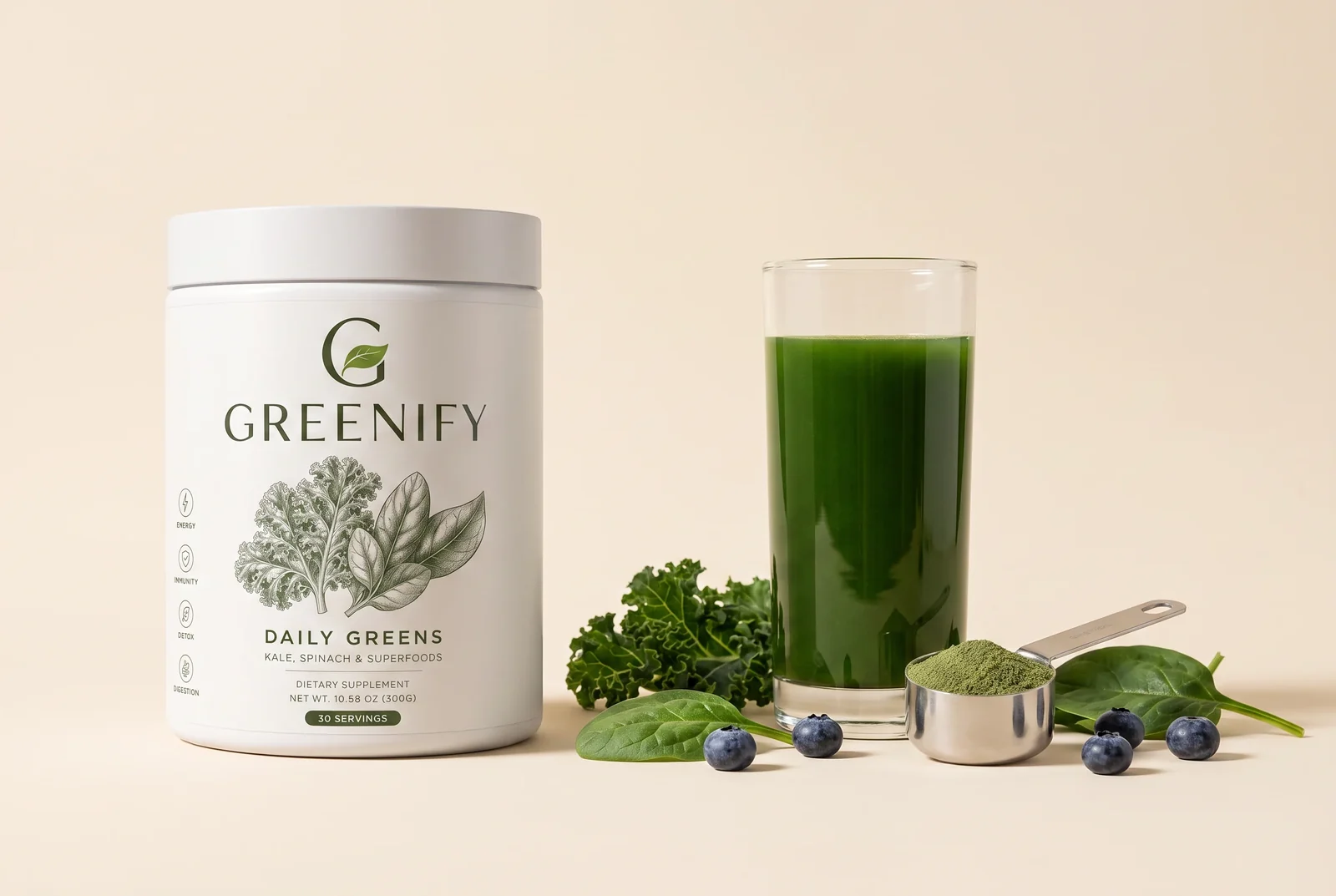
A 4.4g scoop with the blend weights printed on it
56 ingredients, 2.5B CFU across four named strains, five enzymes and three adaptogens — $1.40–$2.33 a day, no subscription, 60-day money-back guarantee.
Frequently asked questions
- Is Live it Up as good as AG1?
- On value and simplicity, Live it Up is the stronger buy as of August 2026 — about $49.99 for 30 servings, or roughly $1.33 a serving on subscription, with a short transparent formula and no artificial sweeteners. On breadth it is not comparable: AG1 carries 75 ingredients, 10 billion CFU and a vitamin and mineral base, plus a 90-day guarantee.
- How much cheaper is Live it Up than AG1?
- Roughly $30 to $50 a month depending on how you buy each one — about $1.33 a serving on subscription for Live it Up against $2.63 for AG1's subscription price and $3.30 for its $99 one-time price.
- Does Live it Up contain artificial sweeteners?
- No. As of August 2026 Live it Up Super Greens is formulated without artificial sweeteners, which is one of the reasons it appears so often on AG1-alternative lists.
- Which has more probiotics?
- AG1 publishes a 10 billion CFU figure for its Next Gen formula, and Live it Up does not headline a comparable number, so check its current panel if live cultures are a priority. If they are and you choose Live it Up on price, a separate probiotic still usually costs less than the difference.