Comparisons
Huel vs AG1 (2026): Huel Daily Greens Compared
Last updated: August 2026
Two kitchen-sink greens powders — 91 ingredients against 75 — at very different prices. Which one earns its list, and which one earns its premium?
Greenify Editorial • August 2, 2026 • 8 min read
Written and fact-checked by the Greenify nutrition team against product labels and published nutrition guidance. Our editorial standards
- Comparison
- Huel
- AG1
- Greens powder

Huel vs AG1 is the same all-in-one idea at two very different prices. Huel Daily Greens and AG1 are the same idea executed at two price points. Both put an unusually long ingredient list into a single daily scoop, both sell primarily by subscription, and both ask you to treat one glass as your nutritional baseline. Huel lists 91 ingredients, many of them organic, at roughly $1.50 a serving. AG1 lists 75 at $79 a month on subscription, or $99 one-time for 30 servings — about $2.63 to $3.30 a serving. When two products share a philosophy and differ by that much in price, the comparison gets sharp fast. Here it is across price, dose transparency, probiotics and enzymes, breadth, taste and guarantee terms, using publicly available information as of August 2026.
Why do people compare Huel Daily Greens and AG1?
Huel launched Daily Greens into a market AG1 had already defined, and the comparison was immediate and intentional. Both products promise comprehensiveness: one scoop, a long list, greens plus vitamins plus botanicals plus digestive support. Both are sold direct with subscription pricing and an ecosystem of related products. The difference the shopper notices first is the receipt — Huel at roughly $1.50 a serving against AG1 at $2.63 or $3.30.
That makes this the cleanest 'is the premium real?' comparison in the category, because you cannot fall back on 'they are different kinds of product'. They are the same kind of product. The question is whether AG1's documentation, probiotic count and guarantee justify roughly double the cost, or whether Huel delivers the same idea for less.
There is a second, less comfortable question that applies to both, and we will not dodge it: what happens when you put 91 or 75 ingredients into a single scoop of powder? Somebody's dose is getting small. Neither label lets you find out whose.
Huel Daily Greens vs AG1: how do they compare on paper?
Verified public figures as of August 2026. Where a brand does not publish something, that is what the cell says.
| Huel Daily Greens | AG1 | |
|---|---|---|
| Price | ~$1.50 per serving | $79/month subscription or $99 one-time, 30 servings |
| Cost per serving | ~$1.50 | ~$2.63 subscription, ~$3.30 one-time |
| Ingredient count | 91 ingredients | 75 ingredients |
| Organic content | Many ingredients organic | Not positioned as organic |
| Dose transparency | Proprietary blends, no individual doses | Mostly proprietary blends, few individual doses |
| Probiotics | Included; CFU not the headline claim | 10 billion CFU (Next Gen formula) |
| Enzymes | Included in the formula | Enzyme blend included |
| Subscription | Subscription-led ecosystem across products | Subscription is the headline price |
| Guarantee | Money-back guarantee — check current terms | 90-day money-back guarantee |
Which is cheaper per serving?
Winner: Huel Daily Greens. At roughly $1.50 a serving it costs about $45 a month against AG1's $79 on subscription — a saving of around $34 monthly, or over $400 a year. Measured against the one-time AG1 price of $99, the gap is closer to $54 a month. For two products built on the same premise, that is a large spread.
Huel also fields more organic ingredients than AG1 does while charging less, which undercuts the usual explanation that premium pricing reflects premium inputs. Part of AG1's price is its marketing footprint, and that is true of any heavily advertised supplement rather than a criticism unique to it.
What the extra money does buy at AG1 is a published 10 billion CFU probiotic figure, third-party testing for banned substances, more supporting documentation than most of the category, and the longest guarantee in it. Whether those four things are worth $34 a month is a genuine judgement call, not an obvious no.
Which one tells you what is actually in the scoop?
Winner: AG1, narrowly, and neither well. Both products place most of their formula inside proprietary blends, so neither publishes the per-ingredient doses that would let you check for token amounts. AG1 gets the narrow edge for publishing its probiotic CFU figure, a vitamin and mineral panel, and more third-party testing documentation than Huel does.
This is the category where the long-list philosophy is most exposed. A scoop of powder is a fixed budget: with 91 ingredients at Huel and 75 at AG1, the average share per ingredient is necessarily small, and the label gives you no way to tell which entries are functional and which are there to make the panel impressive. That is the fairy-dusting question, and it is fair to ask it of both brands rather than only the cheaper one.
In fairness, some ingredients belong in trace amounts — vitamins and minerals are measured in micrograms and milligrams for good reason, and a long list is not automatically dishonest. But the burden of proof sits with the brand, and neither of these two discharges it with printed doses.
Which has better probiotics and enzymes?
Winner: AG1. Its 10 billion CFU figure in the Next Gen formula is published and specific, and Huel does not make an equivalent count its headline claim. If a high probiotic count in the same scoop is part of why you are buying an all-in-one greens powder, AG1 is the product that quantifies it.
Two honest qualifications. CFU is a quantity measure, not a suitability measure: strain selection and viability at end of shelf life matter as much as the number on the front. And a bundled probiotic — in either product — is a convenience rather than a substitute for choosing a probiotic on its own merits.
On enzymes the two are effectively level. Both include enzyme support and neither publishes activity units in comparable form, so there is nothing to separate them beyond marketing language.
Which formula covers more ground?
Winner: Huel Daily Greens, on the raw count — 91 ingredients against 75, with more of them organic. If breadth is the metric you care about, the cheaper product wins it, which is an awkward result for the premium positioning and worth stating plainly.
It is also a result worth holding lightly. Ingredient count is the easiest number in this industry to inflate and the least informative once it passes a certain point. Sixteen extra names in the same size scoop does not mean sixteen extra meaningful doses; it may mean the same total of active material spread thinner. Neither brand publishes enough to tell.
So read this category as: Huel wins the count, and neither wins the argument. If you find long lists inherently suspicious, the consistent conclusion is to be sceptical of both rather than to prefer the shorter of two long lists.
Which one actually tastes better?
Winner: unresolved, and we are not going to pretend otherwise. We do not run blind taste panels, and neither of these products has a flavor range broad enough to make range the deciding factor. AG1 sells one core pineapple-vanilla profile that divides opinion sharply. Huel Daily Greens is a mint-leaning greens flavor that also divides opinion, as almost every greens powder does.
What matters practically is that both are single-profile products. If you dislike the taste of the one you bought, your options are cold water, more dilution, or mixing it into juice — there is no alternative flavor waiting in the range. That is a real risk on a product you intend to drink daily for months.
Which is why the guarantee category below matters more than usual here. On a single-flavor product, a long return window is the practical hedge against not liking it.
Which has the better guarantee and subscription terms?
Winner: AG1. Its 90-day money-back guarantee is the most generous published window in the category and it is genuinely useful on a subscription product — three months is long enough to finish a canister, take a break and decide honestly. Huel also offers a money-back guarantee, but confirm the current window and conditions on its site rather than assuming parity.
Both brands are subscription-led, and Huel's ecosystem is broader — meal powders, bars, drinks — which is either a convenience or a nudge depending on how you feel about bundled ranges. AG1's spread between subscription ($79) and one-time ($99) is steep, so the price for staying uncommitted is higher there.
Whichever you pick, price it at the one-time rate when you decide. Subscription pricing is only a real discount if you genuinely intended to buy it again.
So which should you buy?
If the all-in-one philosophy is what you want, Huel Daily Greens is the better value expression of it: more ingredients, more organic content, roughly half the cost. Nothing in the public information suggests you are getting a materially lesser version of the same idea, and the money saved is substantial over a year.
AG1 remains the right buy for a narrower set of reasons, and they are real ones: a published 10 billion CFU count, third-party banned-substance testing that matters if you compete in a tested sport, more documentation than most rivals, and a 90-day guarantee that makes a wrong decision cheap. If those are the things you are shopping for, the premium is not irrational.
Our reservation applies to both. Ninety-one ingredients and seventy-five ingredients in one scoop are the same bet — that breadth beats disclosed dosing — and neither label gives you the numbers to check it. If that bothers you, the more useful question is not which of these two to buy, but whether you would rather have a shorter formula with the weights printed on it.
Publisher disclosure
Full disclosure: we make one too
This article is published by Greenify, and we make a greens powder — Daily Greens. We kept it out of the comparison above on purpose, because a review that quietly steers every category toward the publisher's own product is not a review. Everything above stands on its own: if the honest answer for you is one of the two brands compared, buy that one.
Here is our case, stated plainly so you can check it against the label. Daily Greens prints the weight of each of its four blends on the panel rather than hiding them in one proprietary total, so you can see how a 4.4g scoop is allocated instead of guessing. That scoop carries 56 ingredients, 2.5 billion CFU across four named probiotic strains, five digestive enzymes and three adaptogens — a narrower ingredient count than the kitchen-sink formulas, at weights you can read. It runs $1.40–$2.33 per day depending on the pack you choose, there is no subscription to cancel, and it is covered by a 60-day money-back guarantee. Our probiotic count is lower than several products above, and if maximum CFU is your priority you should buy on that.
| Greenify Daily Greens | |
|---|---|
| Price per day | $1.40–$2.33, no subscription required |
| Ingredients | 56, in four blends with printed weights |
| Dose transparency | Each blend weight disclosed (2.6g superfood, 1.2g herbs, 406mg fiber) |
| Probiotics | 2.5 billion CFU, four named strains |
| Enzymes | Five digestive enzymes |
| Adaptogens | Ashwagandha, Korean ginseng, eleuthero |
| Scoop size | 4.4g |
| Guarantee | 60-day money-back |
Published by Greenify
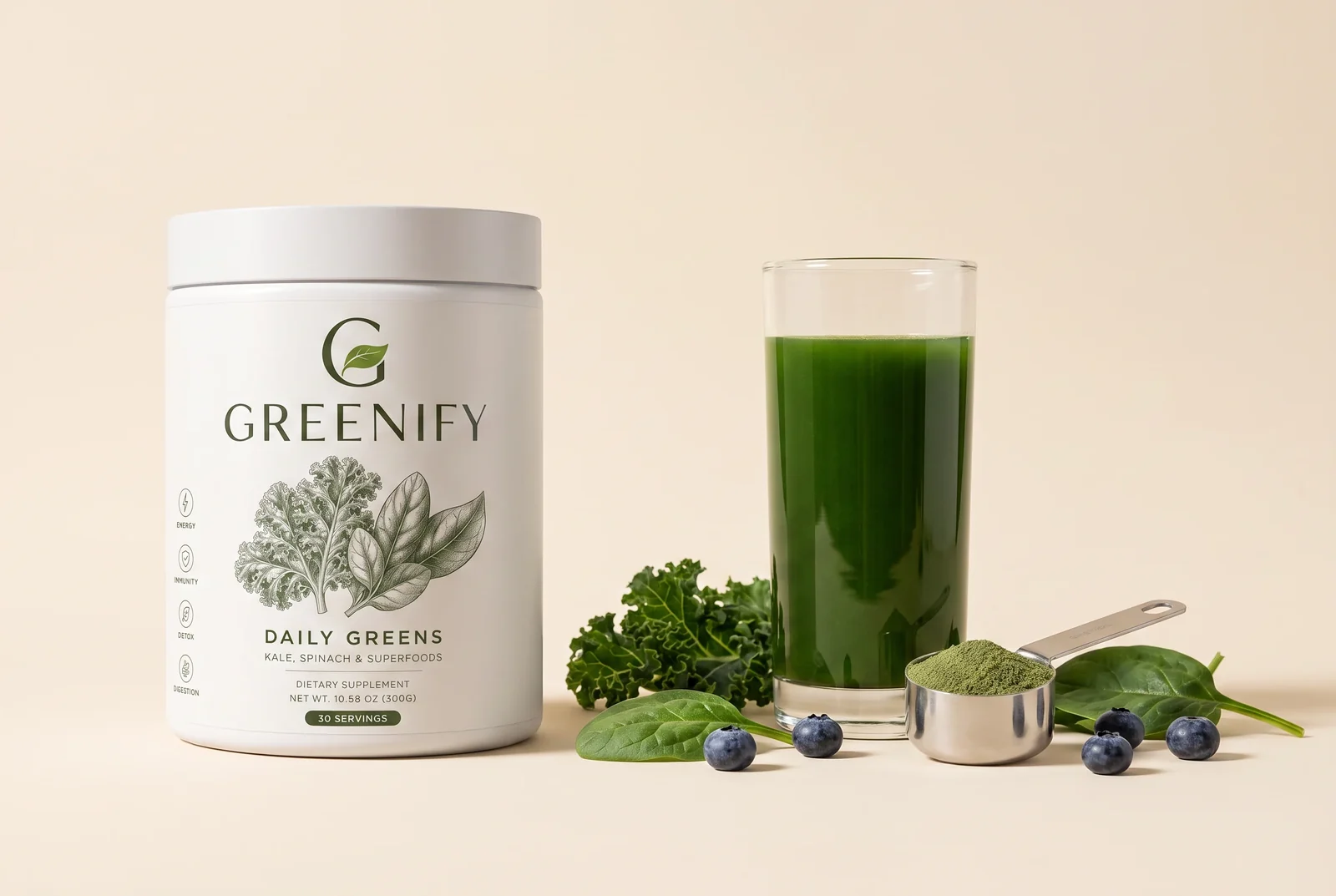
A 4.4g scoop with the blend weights printed on it
56 ingredients, 2.5B CFU across four named strains, five enzymes and three adaptogens — $1.40–$2.33 a day, no subscription, 60-day money-back guarantee.
Frequently asked questions
- Is Huel Daily Greens as good as AG1?
- On the terms both brands compete on, it holds up well: as of August 2026 Huel lists 91 ingredients with many organic at roughly $1.50 a serving, against AG1's 75 at $2.63–$3.30. AG1 leads on its published 10 billion CFU probiotic figure, third-party banned-substance testing and its 90-day guarantee. Neither publishes individual ingredient doses.
- Why is AG1 more than twice the price of Huel Daily Greens?
- AG1 points to its probiotic content, third-party testing, documentation and 90-day guarantee. Marketing spend is also a component of the price of any heavily advertised supplement. It is not explained by ingredient count, since Huel lists more.
- Does a longer ingredient list mean a better greens powder?
- Not by itself. A scoop is a fixed weight, so adding ingredients divides the same space — the practice critics call fairy-dusting. Without printed doses you cannot tell which entries are present in meaningful amounts, which is a limitation of both products here.
- Can I cancel either subscription easily?
- Both brands sell primarily by subscription and both allow cancellation, but the mechanics and any minimum commitments change over time — check the current terms at checkout. AG1's one-time price is $99 against $79 on subscription, so buying without a commitment costs more there.