
Comparisons
Field of Greens Alternatives (2026): Cheaper Greens Powders That Print Their Doses
Last updated: August 2026
Field of Greens sells organic sourcing rather than a dose sheet. If you'd rather see the numbers — or pay less for a similar job — here's how the main alternatives stack up.
Greenify Editorial • August 8, 2026 • 10 min read
Written and fact-checked by the Greenify nutrition team against product labels and published nutrition guidance. Our editorial standards
- Field of Greens
- Alternatives
- Comparison
- Greens powder

People searching for Field of Greens alternatives are usually after one of two things: a lower price, or a label that actually prints what's in the scoop, since Field of Greens itself does not headline probiotic counts, enzyme panels or per-ingredient weights the way much of the rest of the category now does. This guide walks through six of the main alternatives — AG1, Organifi, Bloom, Amazing Grass, Live it Up and Jocko Greens — with an honest 'buy this if' line for each, so you can match the switch to the actual reason you're shopping rather than to ingredient counts alone.
Why look beyond Field of Greens?
Field of Greens' pitch is straightforward: USDA-organic fruit and vegetable ingredients, a doctor-formulated backstory, and a roughly $79.95 canister price (check current pricing, as this shifts) for about 30 servings. That's a coherent product for someone who wants exactly that combination, and there's nothing dishonest about it.
The reasons people go looking elsewhere tend to cluster around two things. First, cost: at roughly $2.60–$2.70 a day before any subscription discount, it sits at the premium end of the category. Second, disclosure: the brand does not publish per-ingredient weights, a probiotic CFU figure or a named enzyme panel, so if you want to evaluate a formula on hard numbers rather than a sourcing claim, there's not much to compare against.
None of the alternatives below are a straight upgrade in every respect — several trade one strength for another, and a few cost more, not less. The point of this guide is to match the switch to the actual itch, rather than assume 'alternative' automatically means 'better'.
AG1 — the category's broadest, most expensive option
AG1 runs to roughly 75 ingredients spanning greens, mushroom and herb extracts, vitamins, minerals, prebiotic fiber and a probiotic component the brand states at 10 billion CFU — the highest published probiotic figure of any product in this comparison. It ships at around $79/month on subscription or $99 one-time for 30 servings, and carries a 90-day money-back guarantee, the longest in this list.
Most of those 75 ingredients sit inside proprietary blends, so while the CFU figure is disclosed clearly, the individual weights of the botanical extras are not — you get breadth and a strong probiotic number, but not full itemised transparency either.
Buy this if: you want the broadest, most established formula in the category, you value a stated probiotic figure and a long guarantee window, and price is a secondary concern.
Organifi Green Juice — the lighter, greener-tasting option
Organifi's Green Juice leans on a shorter, more concentrated ingredient list built around superfoods like moringa, spirulina, chlorella, ashwagandha and turmeric, with a lighter, more juice-like taste profile than most of the category. It is USDA-organic certified across its formula, which puts it on similar footing to Field of Greens on that specific claim, and it does not centre a probiotic or enzyme headline any more than Field of Greens does.
Pricing sits in premium territory too, and — as with Field of Greens — the brand does not publish per-ingredient milligram weights for its proprietary blend, so the same dose-transparency caveat applies. Where it differs is mainly in taste positioning and a shorter, more curated ingredient list rather than a broad multi-blend structure.
Buy this if: you specifically dislike the grassy, dense taste some greens powders have and want a lighter, organic-certified option — while accepting the same lack of itemised dosing that Field of Greens has.
Bloom Greens & Superfoods — the budget, social-media-driven option
Bloom is positioned as an accessible, lower-priced entry point, widely promoted through social media, with a formula built around greens, probiotics and digestive enzymes. It typically undercuts AG1 and Field of Greens on price by a wide margin, which is the main reason it comes up in switching conversations.
The trade-off is a shorter overall ingredient list and, as with most of this category, proprietary blending that limits how precisely you can verify individual doses. It has become one of the most heavily marketed products in the space, so it's worth reading the current label directly rather than relying on ad copy, since formulas and claims in fast-growing brands can shift.
Buy this if: price is your primary driver and you're comfortable with a shorter ingredient list in exchange for a meaningfully lower cost per serving than Field of Greens.
Amazing Grass Green Superfood — the long-running, widely available option
Amazing Grass has been sold in mainstream grocery and pharmacy retail for longer than most of the newer direct-to-consumer greens brands, and it's typically one of the cheapest options on a per-serving basis, often available without needing to order direct from a brand website. Its core formula centres on wheatgrass, alfalfa and other grasses along with a smaller fruit and vegetable blend, and organic versions are available.
It generally does not compete on probiotic CFU counts or adaptogen inclusion the way premium brands do, and — like Field of Greens — individual ingredient weights are not typically itemised on the panel. Its main strength is retail availability and a lower shelf price rather than formulation breadth.
Buy this if: you want something cheap, easy to buy in a physical store, and with a long market track record, and you're not shopping specifically for a probiotic or adaptogen headline.
Live it Up Super Greens — the lean, no-frills formula
Live it Up markets itself as a deliberately leaner alternative to sprawling formulas, with a smaller ingredient list built around core greens and superfoods rather than a long roster of extras. Published pricing has typically undercut AG1 by a wide margin for a similar 30-serving count, making it one of the more frequently cited 'AG1 but cheaper' switches.
Its formula transparency sits roughly in line with the rest of the mid-market — some blend weights disclosed, others not — so it's worth checking the current label rather than assuming full itemisation. It doesn't lead with a probiotic or enzyme claim the way AG1 or Bloom do.
Buy this if: you want a smaller, less crowded ingredient list at a price well below AG1's, and you don't need a headline probiotic figure to make the decision.
Jocko Greens — the fitness-audience, single-flavour option
Jocko Greens is marketed through the Jocko Willink fitness and military-adjacent audience, with a formula built around greens, adaptogens and a probiotic component. It typically ships in a single flavour and is positioned as a straightforward, no-nonsense daily habit rather than a broad multi-blend supplement.
Pricing generally sits between the budget options and AG1, and — as with most of this category — check the current label for exact probiotic CFU and ingredient weights rather than assuming parity with any competitor, since the brand's formula and claims can change between production runs.
Buy this if: you're already engaged with that particular fitness community and want a straightforward, single-SKU greens habit rather than a formula with many named blends to evaluate.
How they compare on price and disclosure
The table below lines up what's publicly available for each brand as of August 2026. Where a brand doesn't publish a figure, we've marked it as not published rather than estimating — treat any blank cells as a reason to check the current label yourself before buying.
| Brand | Approx. price/day | Servings | Probiotics disclosed? | Doses printed? |
|---|---|---|---|---|
| Field of Greens | ~$2.60–$2.70 | ~30 | Not published — check label | Not published — check label |
| AG1 | ~$2.60–$3.30 | 30 | Yes — 10 billion CFU | Mostly proprietary blend |
| Organifi Green Juice | Premium — check current pricing | ~30 | Not the headline claim | Mostly proprietary blend |
| Bloom Greens & Superfoods | Budget-tier — check current pricing | ~30 | Yes, but check current label for CFU | Mostly proprietary blend |
| Amazing Grass Green Superfood | Low-cost — check current pricing | ~15–30 depending on size | Not the headline claim | Not published — check label |
| Live it Up Super Greens | Below AG1 — check current pricing | ~30 | Not the headline claim | Partially disclosed |
| Jocko Greens | Mid-tier — check current pricing | ~30 | Included, check current CFU figure | Partially disclosed |
| Greenify Daily Greens | $1.40–$2.33 | 30 | Yes — 2.5 billion CFU, four strains | Yes — all four blend weights printed |
So which should you switch to?
If your issue with Field of Greens is price alone, Bloom, Amazing Grass and Live it Up are the most likely to land meaningfully cheaper per serving — check current listings, since promotional pricing moves fast in this category. If your issue is dose transparency, none of the mainstream competitors fully solve that problem either, since most of the category still leans on proprietary blends.
If you specifically want printed blend weights rather than a total-ingredient-count marketing figure, that's the gap Daily Greens was built to close — 56 ingredients across four blends with the gram weights printed, 2.5 billion CFU across four named strains, five digestive enzymes and three adaptogens, at $1.40–$2.33 a day with no subscription requirement and a 60-day money-back guarantee.
Whichever you land on, the same rule applies across every brand in this piece, including Field of Greens and including ours: read the current label rather than the ad copy, check the per-serving price against the actual serving count on the panel, and buy on doses you can verify rather than on ingredient counts you can't.
Publisher disclosure
Full disclosure: we make one too
This article is published by Greenify, and we make a greens powder — Daily Greens. We have tried to keep this review honest rather than steering you toward our own product, and the analysis above stands on its own regardless of what follows here.
For context, here is how ours differs. Daily Greens prints the weight of each of its four blends on the panel — a 2.6g superfood blend, 1.2g of herbs and adaptogens, and 406mg of prebiotic fiber inside a 4.4g scoop — rather than presenting a single whole-food fruit-and-vegetable powder without individual dose disclosure. It carries 56 ingredients, 2.5 billion CFU across four named probiotic strains, five digestive enzymes and three adaptogens (ashwagandha, Korean ginseng, eleuthero). It runs $1.40–$2.33 a day depending on the pack, with no subscription requirement and a 60-day money-back guarantee. Field of Greens leans on organic, doctor-formulated sourcing rather than a probiotic or enzyme headline, and if that whole-food, fruit-and-vegetable framing is what you are after, it is a legitimate reason to prefer it over ours.
| Greenify Daily Greens | |
|---|---|
| Price per day | $1.40–$2.33, no subscription required |
| Ingredients | 56, in four blends with printed weights |
| Dose transparency | Each blend weight disclosed (2.6g superfood, 1.2g herbs, 406mg fiber) |
| Probiotics | 2.5 billion CFU, four named strains |
| Enzymes | Five digestive enzymes |
| Adaptogens | Ashwagandha, Korean ginseng, eleuthero |
| Scoop size | 4.4g |
| Guarantee | 60-day money-back |
Published by Greenify
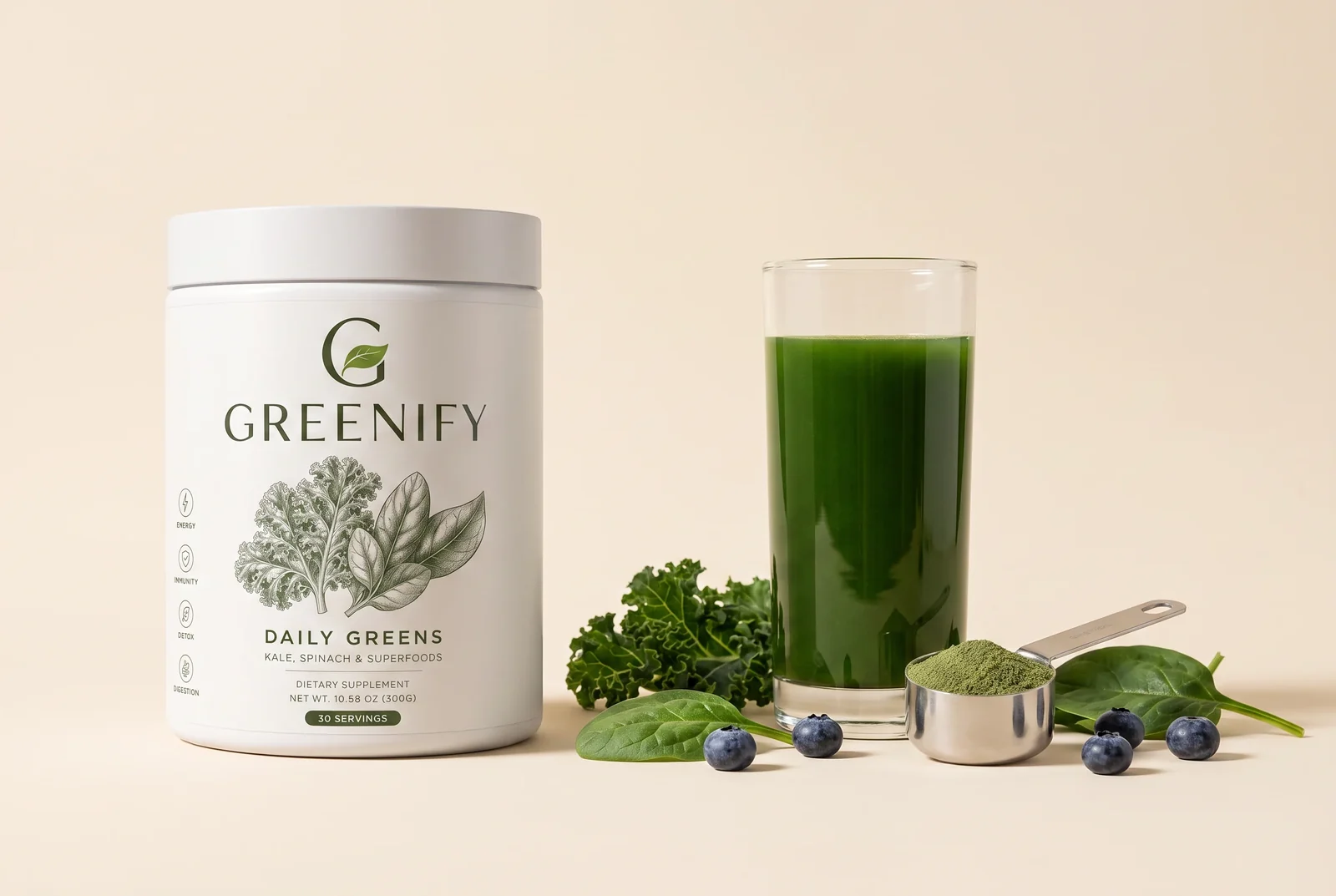
A 4.4g scoop with the blend weights printed on it
56 ingredients, 2.5B CFU across four named strains, five enzymes and three adaptogens — $1.40–$2.33 a day, no subscription, 60-day money-back guarantee.
Frequently asked questions
- What is the closest alternative to Field of Greens?
- It depends on what you are replacing. For a similar whole-food produce blend at a lower price, Amazing Grass Green Superfood and Live it Up Super Greens are the usual swaps. For a formula that prints its blend weights rather than an ingredient count, Greenify Daily Greens is the closer match at $1.40–$2.33 a day.
- Is there a cheaper greens powder than Field of Greens?
- Yes. Field of Greens works out to roughly $2.60–$2.70 a day at list price, and Bloom, Amazing Grass and Live it Up all commonly land below that. Greenify Daily Greens starts at $1.40 a day on its largest option. Promotional pricing moves fast in this category, so check the current listing and the actual serving count before comparing.
- Do any Field of Greens alternatives publish their doses?
- Very few publish per-ingredient milligrams. Most of the category, including Field of Greens, AG1, Organifi and Bloom, discloses ingredient lists but keeps the amounts inside proprietary blends. Live it Up and Jocko Greens disclose partially. Greenify Daily Greens prints all four blend weights plus a 2.5 billion CFU probiotic count across four named strains.
- Why do people switch away from Field of Greens?
- The two reasons that come up most often are price per serving and dose transparency — wanting to know how much of each ingredient is actually in a scoop rather than only how many ingredients are on the label. Taste preference and subscription friction are secondary reasons.
- Are greens powders interchangeable?
- No. Two products can share an ingredient list and still differ enormously in dose, probiotic content and enzyme support. Compare the printed amounts, the serving count on the panel and the return window rather than assuming the labels mean the same thing.