
Comparisons
Field of Greens vs AG1 (2026): Organic Whole Foods vs All-In-One
Last updated: August 2026
Field of Greens is a lean, USDA-organic, whole-food-only powder with a doctor-formulated pitch. AG1 is a 75-ingredient, proprietary-blend all-in-one with a stated CFU count and a longer guarantee. Here's the honest comparison.
Greenify Editorial • August 8, 2026 • 9 min read
Written and fact-checked by the Greenify nutrition team against product labels and published nutrition guidance. Our editorial standards
- Comparison
- Field of Greens
- AG1
- Greens powder

Field of Greens vs AG1 is a comparison between the category's leanest organic option and its broadest all-in-one. These two products end up on the same shortlist for opposite reasons: Field of Greens is chosen by buyers who want organic certification and a short, whole-food-only ingredient list, while AG1 is chosen by buyers who want the widest possible net of ingredients in one scoop, backed by a stated probiotic count and a long guarantee window. This comparison works through price, sourcing philosophy, dose disclosure, probiotics, taste and guarantee terms as of August 2026, and ends with an honest read on who each product actually suits.
Why are Field of Greens and AG1 compared?
Both products are marketed to the same broad wellness audience and both promise to cover nutritional gaps in a single daily scoop, which puts them on the same shortlist even though their underlying philosophies are close to opposite. Field of Greens, made by Brickhouse Nutrition, is a lean, USDA-organic, whole-food-only fruit-and-vegetable powder built around a doctor-formulated story. AG1 is a 75-ingredient all-in-one drink spread across proprietary blends, with a stated probiotic count and a long list of vitamins, minerals, adaptogens and mushroom extracts.
The comparison is genuinely useful because it forces a real choice: do you want the simplicity and traceability of a short, whole-food list, or the breadth of a formula that tries to cover greens, probiotics, adaptogens and micronutrients all at once? Neither answer is wrong, but they lead to very different products.
This article works through what each brand publishes as of August 2026, and is explicit anywhere a figure is not published rather than estimating one.
Field of Greens vs AG1: how do they compare on paper?
Here is what we can verify from public pricing and label copy as of August 2026. Where a brand does not publish a figure, we leave it stated as such rather than guessing.
| Field of Greens | AG1 | |
|---|---|---|
| Category | USDA-organic whole-food fruit-and-vegetable powder | All-in-one greens and micronutrient drink |
| Price | ~$79.95 per canister one-time, lower on subscription (check current pricing) | $79/month subscription, $99 one-time |
| Servings per container | ~30 | 30 |
| Cost per serving | ~$2.66 one-time (subscription lower — check current rate) | ~$2.63 subscription, ~$3.30 one-time |
| USDA Organic certified | Yes | No |
| Ingredient count | Whole-food fruit and vegetable powders (count not the headline) | ~75 ingredients |
| Dose transparency | Whole-food list, individual weights not published — check current label | Mostly proprietary blends |
| Probiotics | Not a headline claim — check current label | 10 billion CFU (Next Gen formula) |
| Flavour options | Not published — check current label | Single pineapple-vanilla flavour |
| Guarantee | Check current brand terms | 90-day money-back |
| Positioning | Doctor-formulated, organic whole foods | Broadest ingredient list in the category, subscription-first |
Which is cheaper per serving?
Winner: it depends on which Field of Greens price you use. At the one-time canister price of roughly $79.95 for about 30 servings, Field of Greens costs around $2.66 a serving, close to AG1's one-time rate of about $3.30. On subscription, Field of Greens' price drops below that figure, and AG1's subscription rate of $79/month works out to roughly $2.63 a serving — so on subscription pricing the two brands land in a similar range, with the exact gap depending on each brand's current discount, which is worth checking before buying either.
Neither product is dramatically cheaper than the other once subscription pricing is accounted for on both sides. The more meaningful difference is structural: AG1's advertised price is built around its $79 subscription, while Field of Greens' headline figure is the one-time canister price with subscription savings layered on top. Compare like for like — one-time to one-time, subscription to subscription — rather than AG1's subscription rate against Field of Greens' list price.
As always with supplement pricing, check both brands' current checkout pages before deciding, since subscription discounts and canister sizes are the parts of a listing most likely to change between when this was written and when you read it.
Which one tells you what is actually in the scoop?
Winner: Field of Greens, on structure, though it has its own disclosure gap. Because Field of Greens is built entirely from whole fruit-and-vegetable powders rather than proprietary blends of extracts and isolated compounds, there is no blend total hiding a mix of unknown-quantity ingredients — what you see on the ingredient list is closer to what you are getting, even though individual fruit and vegetable weights within the formula are not published as of August 2026.
AG1 places most of its 75 ingredients inside proprietary blends, so you can read the full list and the blend totals but not how much of any single item is present. That is standard practice across the category and not unique to AG1, but it does mean a shopper cannot verify the amount of any one adaptogen, mushroom extract or herb relative to the others.
Credit where it is due: AG1 publishes more supporting documentation than most competitors and states its 10 billion CFU figure plainly, which is more disclosure than many greens brands offer on the probiotic front specifically. Field of Greens' strength is the other axis — food-based simplicity rather than a stated CFU number.
Which has the stronger probiotic and gut-health case?
Winner: AG1, on the numbers it publishes. A stated 10 billion CFU in its Next Gen formula is a specific, verifiable figure, and it is one of the higher published counts in the category. Field of Greens does not lead with a probiotic claim, and we could not find a published CFU figure on its current marketing as of August 2026 — if a stated probiotic count matters to you, check Field of Greens' current label directly before assuming either way.
That said, a stated CFU count is not the only route to gut support. Whole-food fiber, which is central to Field of Greens' formula, can support digestion independently of a formulated probiotic blend, and Field of Greens has never positioned itself as a probiotic-first product — its pitch is organic whole foods, not gut-microbiome specifics.
If you are shopping specifically for a probiotic supplement and want the number in writing, AG1 gives you that. If you are shopping for a short, organic, whole-food ingredient list and are comfortable without a stated probiotic claim, Field of Greens' approach may suit you better.
Which one fits your routine better?
Winner: it depends entirely on what you are optimising for, which is the honest answer rather than a dodge. If you want the widest possible net of vitamins, minerals, adaptogens, mushroom extracts and a stated probiotic count in a single scoop, and you do not mind a proprietary-blend structure or a subscription-first pricing model, AG1 is built for exactly that and does it at scale.
If you want a short, traceable, USDA-organic ingredient list built from whole foods rather than extracts, and a doctor-formulated brand story matters to you, Field of Greens is the leaner, more food-focused option of the two.
The trap is buying either product expecting it to be the other. AG1 is not trying to be a minimalist whole-food powder, and Field of Greens is not trying to be the broadest ingredient list in the category. Decide which philosophy you actually want before comparing price tags.
Which has the better guarantee and subscription terms?
Winner: AG1, on what is published. A 90-day money-back guarantee is among the longest windows in the category and fits how these products are meant to be judged — you cannot fairly assess a daily habit over a week or two. Field of Greens' current guarantee terms should be checked directly on its brand page before you buy; we are not going to state a window we cannot verify as of August 2026.
Both brands use subscription pricing to reach their lowest advertised rate, and both charge more for a one-time purchase — AG1 is $99 rather than $79, and Field of Greens' one-time canister price sits above its subscription rate. If you dislike managing auto-ship, compare both brands at their one-time prices rather than their subscription headlines.
One point worth flagging for either brand: subscription discounts and guarantee windows are the parts of a supplement listing most likely to change without much notice, so treat anything stated here as a snapshot and confirm on the current order page before you commit.
So which should you buy?
Buy Field of Greens if USDA organic certification and a short, whole-food-only ingredient list are what you are shopping for, and you are comfortable with a formula that does not itemise a probiotic count or individual ingredient weights.
Buy AG1 if you want the broadest ingredient list in the category in one scoop, a stated 10 billion CFU probiotic figure, and the longer 90-day guarantee — and subscription pricing does not bother you.
It is also worth saying that plenty of shoppers would be equally well served by a leaner, disclosed-dose alternative to both. If printed blend weights matter to you as much as organic sourcing or ingredient breadth, it is worth reading a wider comparison before settling on either of these two.
Publisher disclosure
Full disclosure: we make one too
This article is published by Greenify, and we make a greens powder — Daily Greens. We kept it out of the comparison above on purpose, because a review that quietly steers every category toward the publisher's own product is not a review. Everything above stands on its own: if the honest answer for you is Field of Greens or AG1, buy that one.
Here is our case, stated plainly so you can check it against the label. Daily Greens prints the weight of each of its four blends on the panel rather than hiding them in one proprietary total, so you can see how a 4.4g scoop is allocated instead of guessing. That scoop carries 56 ingredients, 2.5 billion CFU across four named probiotic strains, five digestive enzymes and three adaptogens. It runs $1.40–$2.33 per day depending on the pack you choose, there is no subscription to cancel, and it is covered by a 60-day money-back guarantee. We are not USDA-organic certified across the board the way Field of Greens is, and our probiotic count is lower than AG1's — if either of those is your priority, buy on that.
| Greenify Daily Greens | |
|---|---|
| Price per day | $1.40–$2.33, no subscription required |
| Ingredients | 56, in four blends with printed weights |
| Dose transparency | Each blend weight disclosed (2.6g superfood, 1.2g herbs, 406mg fiber) |
| Probiotics | 2.5 billion CFU, four named strains |
| Enzymes | Five digestive enzymes |
| Adaptogens | Ashwagandha, Korean ginseng, eleuthero |
| Scoop size | 4.4g |
| Guarantee | 60-day money-back |
Published by Greenify
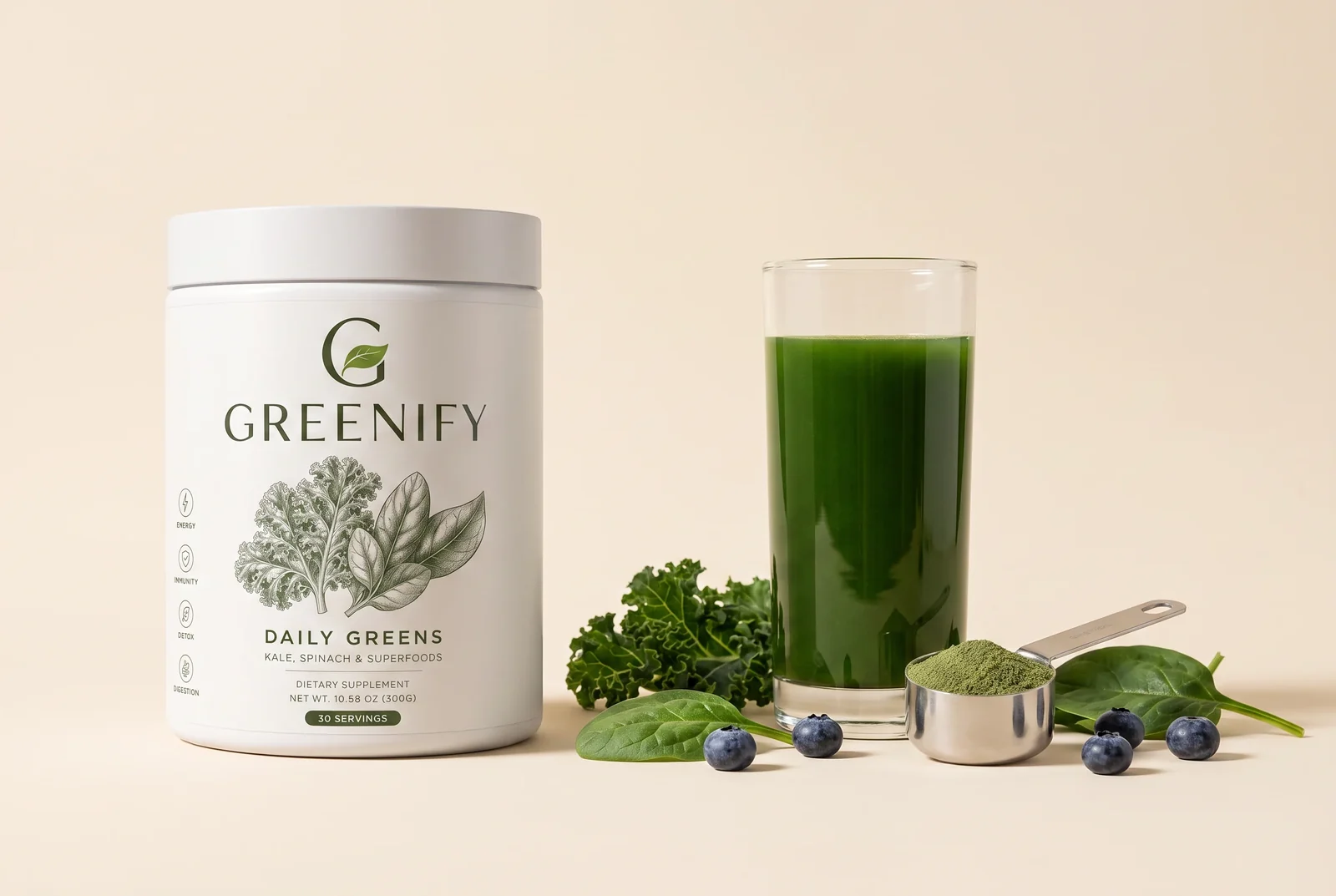
A 4.4g scoop with the blend weights printed on it
56 ingredients, 2.5B CFU across four named strains, five enzymes and three adaptogens — $1.40–$2.33 a day, no subscription, 60-day money-back guarantee.
Frequently asked questions
- Is Field of Greens the same as AG1?
- No. As of August 2026, Field of Greens is a USDA-organic, whole-food-only fruit-and-vegetable powder made by Brickhouse Nutrition, priced around $79.95 per canister one-time. AG1 is a 75-ingredient all-in-one drink with a stated 10 billion CFU probiotic count, priced at $79/month subscription or $99 one-time for 30 servings. They take different approaches to the same daily habit.
- Does Field of Greens have probiotics like AG1 does?
- AG1 states a 10 billion CFU probiotic count in its Next Gen formula. Field of Greens does not headline a probiotic claim, and we could not find a published CFU figure on its current marketing as of August 2026 — check the current label directly if this matters to your decision.
- Which is more expensive, Field of Greens or AG1?
- At one-time prices, Field of Greens (~$2.66/serving from a ~$79.95 canister) and AG1 (~$3.30/serving from $99) are broadly comparable, with Field of Greens slightly cheaper. On subscription, AG1's $79/month works out to about $2.63/serving; Field of Greens' subscription rate is lower than its one-time price but should be checked on the current order page.
- Is Field of Greens organic and is AG1 organic?
- Field of Greens is USDA Organic certified. AG1 is not marketed as an organic-certified product. If organic certification is a requirement, Field of Greens is the option that meets it as of August 2026.
- Can you take Field of Greens and AG1 together?
- Some people do, since one is a lean whole-food powder and the other is a broader all-in-one, but the combined daily cost and the overlap in plant ingredients are both worth weighing. If budget or ingredient overlap matters to you, pick the one that matches your actual priority — organic whole-food simplicity or ingredient breadth with a stated probiotic count — rather than stacking both.