
Comparisons
Field of Greens vs Bloom Greens (2026): Organic Whole Foods vs Flavour and Price
Last updated: August 2026
Field of Greens sells on organic whole-food sourcing at a premium price. Bloom Greens & Superfoods sells on flavour, bloating relief and being roughly half the price. Here is how they actually compare.
Greenify Editorial • August 8, 2026 • 9 min read
Written and fact-checked by the Greenify nutrition team against product labels and published nutrition guidance. Our editorial standards
- Comparison
- Field of Greens
- Bloom Greens
- Greens powder
- Budget

Field of Greens vs Bloom Greens is a comparison between a premium organic pick and the category's most visible budget option. These two products sit at very different points on the shelf even though they are shopped by overlapping people. Field of Greens is priced at roughly $79.95 one-time for a canister of about 30 servings as of August 2026, and it is marketed almost entirely on USDA-organic sourcing and a doctor-formulated, whole-food framing rather than on a printed per-ingredient breakdown. Bloom Greens & Superfoods sits at roughly $39.99 for 30 servings — about $1.33 a serving — and leans heavily on flavour variety and bloating-relief messaging, with a proprietary blend that does not disclose individual ingredient weights. This comparison works through price, transparency, formula philosophy and taste, with figures checked against publicly available pricing as of August 2026.
Why do people compare Field of Greens and Bloom Greens?
Both brands show up in the same 'best greens powder' searches and both are aimed at people trying their first greens supplement, but they are pitched at almost opposite ends of the price spectrum, and that gap is exactly why shoppers put them side by side — one is roughly double the price of the other for the same nominal serving count.
Field of Greens' entire pitch rests on organic certification and a doctor-formulated, whole-food story: the implicit argument is that you are paying more because the sourcing is better and the product is closer to dehydrated produce than to a typical supplement blend. Bloom's pitch is almost the mirror image: it leans on approachability — a lower price, a wide range of flavours, and messaging built around bloating relief and taste rather than sourcing credentials.
Neither pitch is dishonest, but they are answering different questions. Field of Greens is arguing that its ingredients justify a premium. Bloom is arguing that most people do not need that premium to get a daily greens habit that they will actually keep drinking. Which argument is right for you depends on what you are optimising for.
Field of Greens vs Bloom Greens: how do they compare on paper?
Below are the figures both brands publish themselves, read off current listings and label copy in August 2026. Where a number is not printed anywhere public, we leave it marked as unpublished instead of guessing at it.
| Field of Greens | Bloom Greens & Superfoods | |
|---|---|---|
| Category | Organic whole-food fruit & vegetable powder | Flavoured greens & superfoods blend |
| Price (one-time) | ~$79.95 for ~30 servings | ~$39.99 for 30 servings |
| Cost per serving | ~$2.66, lower on subscription | ~$1.33 |
| Organic certification | USDA organic | Not organic-certified — check current label |
| Dose transparency | Organic sourcing emphasised over per-ingredient weights | Proprietary blend; individual weights not disclosed |
| Probiotics | Not published — check current label | Not the product's headline claim — check current label |
| Flavour range | One core fruit-forward profile | Multiple flavour options |
| Headline marketing angle | Doctor-formulated, whole-food, organic | Taste and bloating relief |
| Guarantee | Check current brand terms | Check current brand terms |
Which is cheaper?
Winner: Bloom Greens, decisively. At roughly $39.99 for 30 servings against Field of Greens' roughly $79.95 for a similarly sized canister, Bloom is close to half the price on a per-serving basis — about $1.33 against $2.66. Over a year of daily use, that gap adds up to several hundred dollars, which is a meaningful amount of money for most households.
This is one of the largest price gaps you will find between two mainstream greens powders that are marketed to a similar audience, and it is worth being honest that price alone would make Bloom the obvious pick for a lot of shoppers. The question the rest of this comparison has to answer is whether Field of Greens' organic, whole-food positioning is worth roughly double the money to you specifically.
It is also worth noting that Field of Greens' subscription pricing brings its per-serving cost down somewhat, and Bloom's introductory bundles sometimes undercut its own standard price further — so treat both numbers as starting points and check the current cart total before assuming either figure is fixed.

Which one tells you what is actually in the scoop?
Winner: neither, in the sense that both brands rely heavily on marketing framing rather than a fully itemised, per-ingredient weight breakdown, which is worth naming plainly rather than picking a winner that does not exist. Field of Greens sells on organic sourcing and a doctor-formulated story rather than on a printed count of ingredients with individual weights. Bloom uses a proprietary blend structure that names its ingredients without disclosing how much of each is actually in the scoop.
If dose transparency is your primary concern, this comparison does not have a satisfying answer on either side — both require a level of trust in the brand's formulation claims that a fully disclosed label would not. That is a fair criticism of the category generally, not just of these two products specifically.
The one place the two brands do differ is in what they are asking you to trust. Field of Greens is asking you to trust that organic-certified produce sourcing produces a meaningfully better product. Bloom is asking you to trust that its proprietary blend delivers on its bloating-relief and flavour claims. Neither claim is independently verifiable from the label alone.
Which formula fits the job better?
Winner: it depends on what you are prioritising. If your main goal is a product built and marketed around organic, whole-food fruit-and-vegetable sourcing — structure-and-function language, not a medical claim — Field of Greens is the more literal match, and that positioning is central to almost everything the brand publishes.
If your main goal is a daily habit you can actually sustain at a lower cost, with flavour variety to prevent the boredom that derails a lot of supplement routines, Bloom's approach is built specifically for that use case. Its bloating-relief messaging also targets a specific, common complaint about greens powders generally — that they can feel harsh on the stomach — though we are not making a claim about how effectively either product addresses that for you personally.
Neither product is a substitute for eating vegetables, a multivitamin, or medical care, and neither brand claims otherwise in its current published marketing as far as we can verify. Both are best thought of as an addition to a reasonable diet.
Which one actually tastes better?
Winner: likely Bloom, based on how consistently flavour is cited as its strongest selling point across independent reviews, and on the simple fact that offering multiple flavours gives a shopper more chances to find one they genuinely enjoy. We have not run a blind taste test ourselves, so treat this as a synthesis of widely reported opinion rather than a lab result.
Field of Greens is also marketed as palatable, with a fruit-forward profile designed to mask the vegetable content, and many users report it as easy to drink. But it offers a single core profile rather than a range, so if that particular flavour does not suit you, there is less room to switch within the brand.
Flavour matters more for adherence than most buyers expect going in — the product that tastes good enough to finish every day beats the theoretically superior one that ends up half-used in a cupboard. If you have a history of abandoning greens powders specifically over taste, that is a real point in Bloom's favour.
Which has the better guarantee and terms?
Neither brand's current return policy is one we are prepared to state a specific window for without you checking it directly, since guarantee terms are exactly the kind of detail that changes without notice. Look up the current money-back policy on each brand's own order page before buying either.
Both brands offer subscription pricing that typically undercuts a one-time purchase, and both run periodic promotional bundles — introductory multi-canister discounts are common in this category. If you are comparing the two on price, check both at their current, non-promotional one-time rate first, since that is the number you will pay by default if you do not opt into a subscription.
As with most direct-to-consumer supplement brands, pricing and bundle structures shift often enough that any specific figure in this article — including our own — should be treated as a snapshot from August 2026 rather than a permanent number.
So which should you buy?
Buy Field of Greens if organic certification and a whole-food, produce-forward story are worth roughly double the price to you, and you are comfortable with a single flavour profile and a marketing approach that leans on sourcing rather than a fully itemised ingredient breakdown.
Buy Bloom Greens if price and flavour variety are your priorities, and the absence of an organic certification is not a deciding factor for you. For a lot of first-time greens-powder buyers, Bloom's lower cost and flavour range make it the easier product to actually stick with day to day.
Whichever you choose, treat the organic label and the bloating-relief claim as marketing framing rather than as guarantees, and check the current label on either product before buying, since formulas, pricing and promotional bundles change more often in this category than most shoppers expect.
Publisher disclosure
Full disclosure: we make one too
This article is published by Greenify, and we make a greens powder — Daily Greens. We kept it out of the comparison above on purpose, because a review that quietly steers every category toward the publisher's own product is not a review. Everything above stands on its own: if the honest answer for you is one of the two brands compared, buy that one.
Here is our case, stated plainly so you can check it against the label. Daily Greens prints the weight of each of its four blends on the panel rather than hiding them in one proprietary total, so you can see how a 4.4g scoop is allocated instead of guessing. That scoop carries 56 ingredients, 2.5 billion CFU across four named probiotic strains, five digestive enzymes and three adaptogens — a narrower ingredient count than the kitchen-sink formulas, at weights you can read. It runs $1.40–$2.33 per day depending on the pack you choose, there is no subscription to cancel, and it is covered by a 60-day money-back guarantee. Neither brand compared above publishes a probiotic count, so if that matters to you, check current labels before assuming ours is higher or lower than what you already take.
| Greenify Daily Greens | |
|---|---|
| Price per day | $1.40–$2.33, no subscription required |
| Ingredients | 56, in four blends with printed weights |
| Dose transparency | Each blend weight disclosed (2.6g superfood, 1.2g herbs, 406mg fiber) |
| Probiotics | 2.5 billion CFU, four named strains |
| Enzymes | Five digestive enzymes |
| Adaptogens | Ashwagandha, Korean ginseng, eleuthero |
| Scoop size | 4.4g |
| Guarantee | 60-day money-back |
Published by Greenify
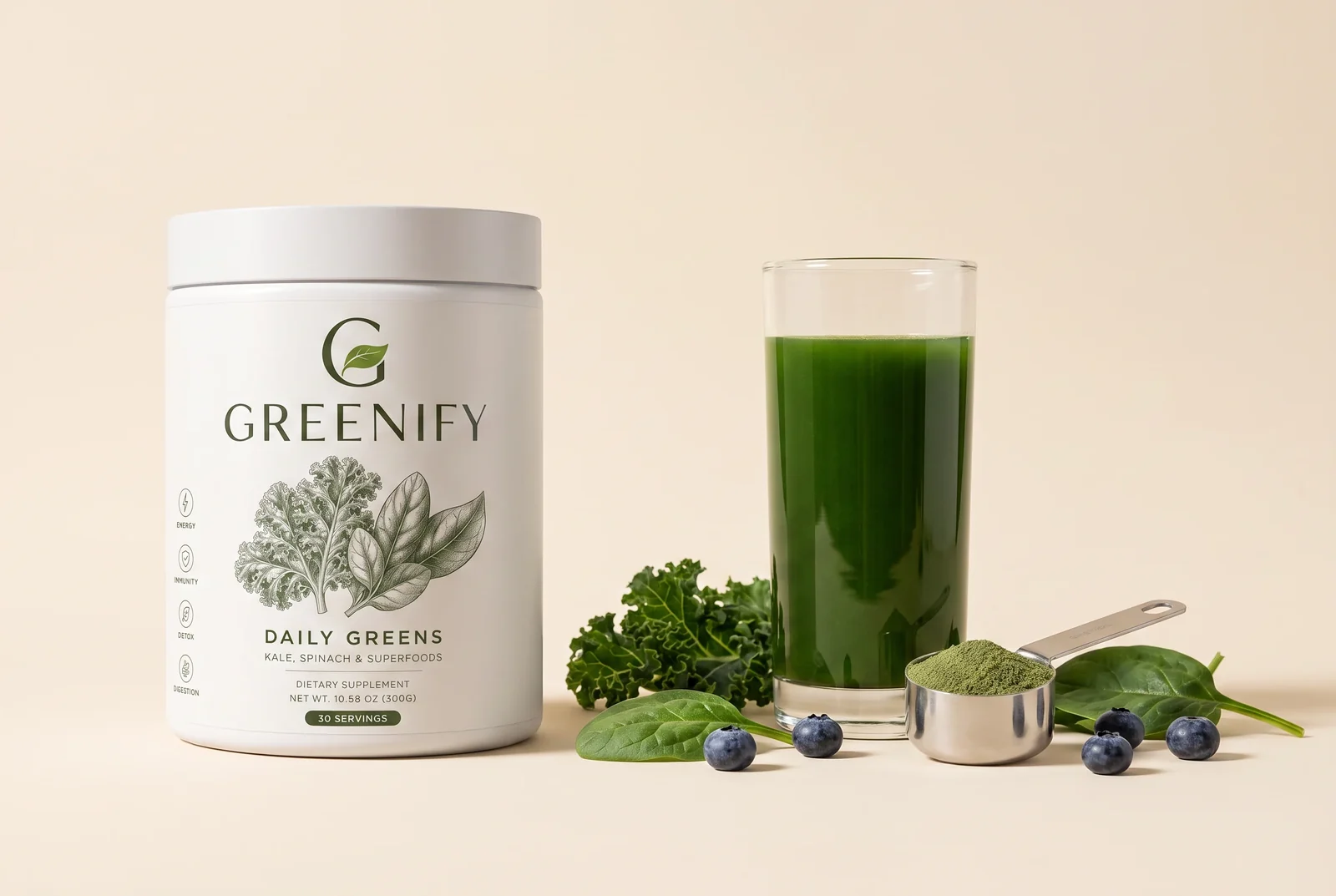
A 4.4g scoop with the blend weights printed on it
56 ingredients, 2.5B CFU across four named strains, five enzymes and three adaptogens — $1.40–$2.33 a day, no subscription, 60-day money-back guarantee.
Frequently asked questions
- Is Field of Greens worth the extra price over Bloom Greens?
- That depends on what you value. Field of Greens is roughly double Bloom's price as of August 2026, and the extra cost buys USDA-organic certification and a whole-food, doctor-formulated positioning rather than a longer or more transparent ingredient list. If organic sourcing matters to you specifically, it may be worth it; if price and flavour variety matter more, Bloom is the cheaper route to a similar daily habit.
- Is Bloom Greens organic?
- Bloom Greens & Superfoods is not marketed with an organic certification as of August 2026 — check the current label to confirm, since formulas and certifications can change. Field of Greens carries USDA organic certification.
- Which is better for bloating, Field of Greens or Bloom?
- Bloom markets itself heavily on bloating relief; Field of Greens does not lead with that claim in its current public marketing. We are not making a medical claim about either product's effect on digestion — if bloating is a specific concern, discuss it with a healthcare provider rather than relying on marketing copy from either brand.
- Does either brand disclose individual ingredient weights?
- No. Field of Greens markets on organic sourcing rather than a printed per-ingredient breakdown, and Bloom uses a proprietary blend that names ingredients without disclosing individual weights. Neither is unusual for the category, but shoppers who want full dose transparency will not get it from either label as published.
- Which has more flavour options, Field of Greens or Bloom?
- Bloom offers a wider range of flavour options as of August 2026. Field of Greens is built around a single core fruit-forward profile. If flavour variety matters to you, check each brand's current flavour lineup, since offerings change.